© examsnet.com
Question : 42 of 42
Marks: +1, -0
An electric motor rated 1100 W1100 \text{ W} is connected to 220 V220 \text{ V} mains. Find :
(i) The current drawn from the mains,
(ii) Electric energy consumed if the motor is used for 5 hours daily for 6 days.
(iii) Total cost of energy consumed if the rate of one unit is ₹ 5.
OR
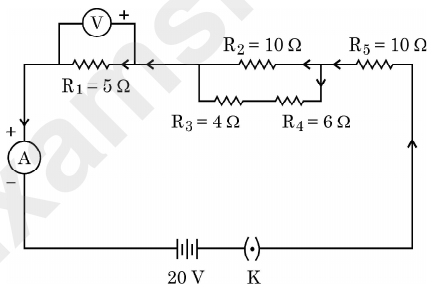
Study the following circuit and find :
(i) Effective resistance of the circuit
(ii) Current drawn from the battery
(iii) Potential difference across the 5 Ω5 \, \Omega resistor
[CBSE 2022 31/4/1]
Solution:  
Given:
P=1100 WP = 1100 \text{ W}, V=220 VV = 220 \text{ V}
(i) Current drawn
I=PV=1100 W220 V=5 AI = \dfrac{P}{V} = \dfrac{1100 \text{ W}}{220 \text{ V}} = 5 \text{ A}
(ii) Energy consumed
Time t=5 h/day×6 days=30 ht = 5 \text{ h/day} \times 6 \text{ days} = 30 \text{ h}
E=P×t=1100 W×30 h=33000 Wh=33 kWhE = P \times t = 1100 \text{ W} \times 30 \text{ h} = 33000 \text{ Wh} = 33 \text{ kWh}
(In joules: 33×3.6×106 J=1.188×10⁸ J33 \times 3.6 \times 10^6 \text{ J} = 1.188 \times 10^8 \text{ J})
(iii) Cost
1 unit=1 kWh1 \text{ unit} = 1 \text{ kWh}, so energy =33= 33 units
Cost =33×= 33 \times ₹ 5=5 = ₹ 165165
Result: (i) 5 A5 \text{ A} (ii) 33 kWh33 \text{ kWh} (33 units) (iii) ₹ 165
OR
Given: R1=5 ΩR_1 = 5\ \Omega, R2=10 ΩR_2 = 10\ \Omega, R3=4 ΩR_3 = 4\ \Omega, R4=6 ΩR_4 = 6\ \Omega, R5=10 ΩR_5 = 10\ \Omega, V=20 VV = 20 \text{ V}
(i) Effective resistance
R3R_3 and R4R_4 are in series: Rs=4+6=10 ΩR_s = 4 + 6 = 10\ \Omega
This combination is in parallel with R2R_2:
1Rp=110+110=210=15\dfrac{1}{R_p} = \dfrac{1}{10} + \dfrac{1}{10} = \dfrac{2}{10} = \dfrac{1}{5}, so Rp=5 ΩR_p = 5\ \Omega
R1R_1, RpR_p and R5R_5 are in series:
R=R1+Rp+R5=5+5+10=20 ΩR = R_1 + R_p + R_5 = 5 + 5 + 10 = 20\ \Omega
(ii) Current from the battery
I=VR=20 V20 Ω=1 AI = \dfrac{V}{R} = \dfrac{20 \text{ V}}{20\ \Omega} = 1 \text{ A}
(iii) Potential difference across the 5 Ω5\ \Omega resistor (R1R_1, which carries the full current)
V1=IR1=1 A×5 Ω=5 VV_1 = I R_1 = 1 \text{ A} \times 5\ \Omega = 5 \text{ V}
Result: (i) 20 Ω20\ \Omega (ii) 1 A1 \text{ A} (iii) 5 V5 \text{ V}
© examsnet.com
Advertisements
Go to Question: