Test Index
Electricity
Electricity

 CBSE Board Videos
© examsnet.com
Question : 40 of 42
Marks:
+1,
-0
Study the following electric circuit in which the resistors are arranged in three arms A, B and C :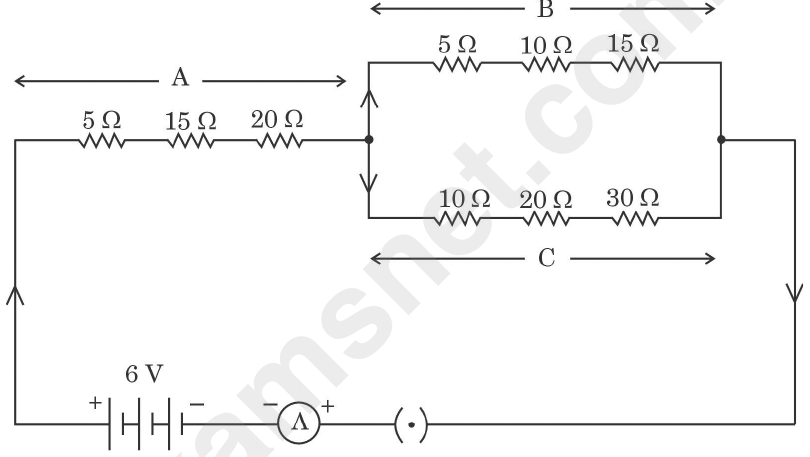 (a) Find the equivalent resistance of arm C. [1](b) Calculate the equivalent resistance of the parallel combination of the arms B and C. [1](c) (i) Determine the current that flows through the ammeter. [2]OR(ii) Determine the current that flows in the ammeter when the arm B is withdrawn from the circuit. [2]
[CBSE 2022 31/3/3]
Solution:
Given:Arm A: , , in seriesArm B: , , in seriesArm C: , , in seriesArms B and C are in parallel, and this combination is in series with arm A. Battery .(a) Arm C (series): (b) Arm B (series): B and C in parallel: (c)(i) Arm A (series): Total resistance: Current through the ammeter: Result: OR (c)(ii) When arm B is withdrawn, arms A and C are in series:Result: (less than before, because removing a parallel arm increases the total resistance)
© examsnet.com
Go to Question: