Test Index
Electricity
Electricity

 CBSE Board Videos
© examsnet.com
Question : 30 of 42
Marks:
+1,
-0
(i) How is electric current related to the potential difference across the terminals of a conductor ?Draw a labelled circuit diagram to verify this relationship.(ii) Why should an ammeter have low resistance ?(iii) Two V - I graphs A and B for series and parallel combinations of two resistors are as shown. Giving reason state which graph shows (a) series, (b) parallel combination of the resistors.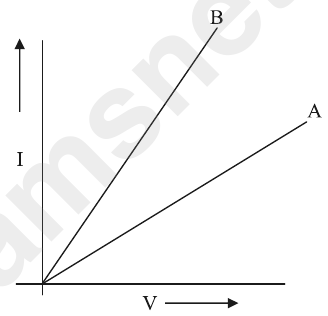
[CBSE 2023 31/4/2]
Solution:
(i)Ohm's law: The electric current flowing through a metallic conductor is directly proportional to the potential difference across its ends, provided its temperature remains the same., i.e. Circuit diagram to verify it: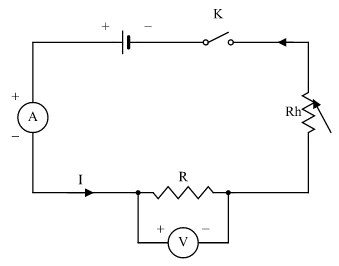 The resistor R, ammeter A, key K, rheostat Rh and cell are in series; the voltmeter V is connected in parallel across R. Change the current with the rheostat and note and each time. The ratio comes out the same, and the – graph is a straight line through the origin, which verifies Ohm's law.(ii)An ammeter is connected in series. If it had a high resistance it would reduce the current it is measuring. A low resistance does not change the current in the circuit, so it reads the true current.(iii)In the – graph (I on the y-axis, V on the x-axis), slope . A smaller slope means a larger resistance.(a) Series combination: graph A. A has the smaller slope, so the larger resistance; resistances in series add up (), giving the larger value.(b) Parallel combination: graph B. B has the larger slope, so the smaller resistance; the equivalent resistance in parallel is less than the smallest individual resistance.
© examsnet.com
Go to Question: