Test Index
Electricity
Electricity

 CBSE Board Videos
© examsnet.com
Question : 25 of 42
Marks:
+1,
-0
(a) (i) The potential difference across the two ends of a circuit component is decreased to one-third of its initial value, while its resistance remains constant. What change will be observed in the current flowing through it ? Name and state the law which helps us to answer this question.(ii) Draw a schematic diagram of a circuit consisting of a battery of four cells, a resistor, a resistor and a resistor and a plug key, all connected in series. Now find (I) the electric current passing through the circuit, and (II) potential difference across the resistor when the plug key is closed.OR(b) (i) When is the potential difference between two points said to be volt ?(ii) A copper wire has a diameter of and resistivity of . What will be the length of this wire to make its resistance ? How much does the resistance change, if the diameter of the wire is doubled ?
[CBSE 2024 31/5/1]
Solution:
(a)(i) The current also becomes one-third of its initial value, since and R is constant: .Law: Ohm's law. The potential difference across the ends of a conductor is directly proportional to the current flowing through it, provided its temperature remains the same: , or .(ii) Circuit diagram: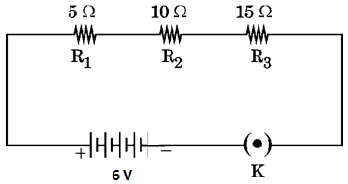 Total voltage Total resistance in series (I) Current (II) Potential difference across the resistor: Result: ; OR (b)(i) The potential difference between two points is volt when joule of work is done to move a charge of coulomb from one point to the other: .(ii) Given: , , Area , so When the diameter is doubled, the area becomes times (), so the resistance becomes one-fourth:Change: the resistance decreases by .Result: Length ; new resistance (decrease of ).
© examsnet.com
Go to Question: