Test Index
Electricity
Electricity

 CBSE Board Videos
© examsnet.com
Question : 10 of 42
Marks:
+1,
-0
As shown in the diagram, an electric circuit consisting of an ammeter, a voltmeter, cells of V each, a plug key with a gap XY was set up. Voltmeter and ammeter readings were recorded in the observation table for four arrangements as given below :Arrangement No. 1 – only resistor in gap XYArrangement No. 2 – only resistor in gap XYArrangement No. 3 – Resistors and in series in gap XYArrangement No. 4 – Resistors and in parallel in gap XY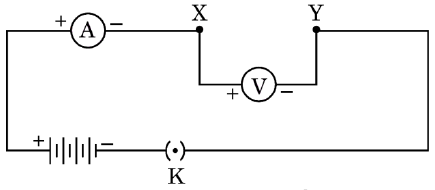 Based on the observations, four V – I graphs A, B, C and D as shown in figure were drawn. Study these graphs.
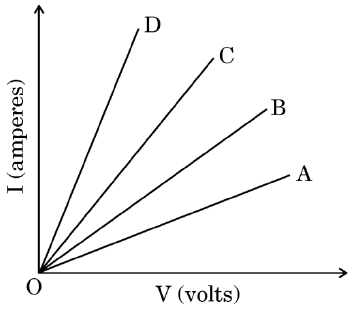 (a) Which one of the graphs represents the series combination of and ? (1)(b) Which one of these graphs represents the parallel combination of and ? (1)(c) (i) Show an arrangement of three resistors, each of resistance , so that the combination has a resistance of . Give justification for your answer. (2)OR(c) (ii) A battery of V is connected with a series combination of five resistors of , , , and . How much current would flow through the resistor ? Justify your answer. (2)
[CBSE 2025 31/3/2]
Solution:
Concept:The graphs plot current against voltage . By Ohm's law , so the slope of each line is : the steeper the line, the smaller the resistance.Series: is larger than either resistor (largest of the four).Parallel: , so is smaller than either resistor (smallest of the four).(a)Graph A: it has the least slope, i.e. the largest resistance, which is the series combination.(b)Graph D: it has the greatest slope, i.e. the smallest resistance, which is the parallel combination.(c)(i)Connect two of the resistors in parallel and join this pair in series with the third resistor.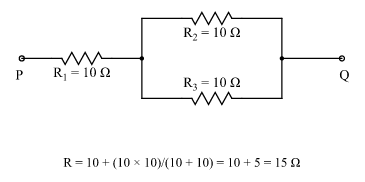 Justification:Parallel pair: , so In series with the third: Result: OR (c)(ii)Given: V; resistors in seriesTotal resistance: Current: AIn a series circuit there is only one path, so the same current flows through every resistor.Result: Current through the resistor A
© examsnet.com
Go to Question: