Test Index
Electricity
Electricity

 CBSE Board Videos
© examsnet.com
Question : 1 of 42
Marks:
+1,
-0
The values of current flowing in a given resistor for the corresponding values of potential difference applied across the ends of resistor are given below in the table :
Plot a graph between and and calculate the resistance of that resistor.
| (Amperes) | |||||
| (Volts) |
[CBSE 2026 31/2/1]
Solution:
Graph:Take current on the x-axis and potential difference on the y-axis, plot the five points and join them. The points lie on a straight line passing through the origin, so (Ohm's law).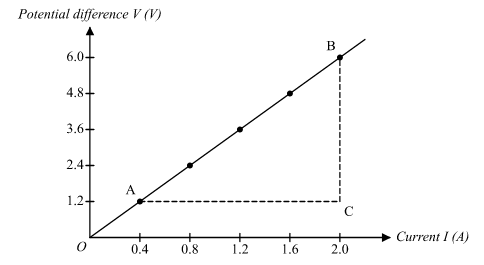 Resistance from the graph:Resistance = slope of the – graph. Take two points on the line, A and B :Check with any single reading: .Result: Resistance of the resistor
© examsnet.com
Go to Question: