Test Index
Carbon and its Compounds
Carbon and its Compounds

 CBSE Board Videos
© examsnet.com
Question : 5 of 35
Marks:
+1,
-0
Attempt either (a) or (b):(a) (i) What is homologous series? Which two of the following organic compounds belong to the same homologous series?, , , (ii) Write the product(s) in the following reactions:(I) (II) (iii) Why does micelle formation take place when soap is added to water? (2 + 2 + 1 = 5)OR(b) (i) Name the following compounds: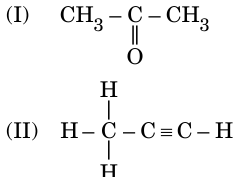 (ii) Name the reaction which is commonly used in the conversion of vegetable oils to fats.(iii) Why is the melting point of higher than ?(iv) What happens when a piece of sodium is dropped into ethanol?(v) Write the products in the following reaction:
[CBSE 2026 31/3/1]
Solution:
(a)(i)A homologous series is a series of organic compounds in which the same functional group substitutes for hydrogen in a carbon chain. Its members have the same general formula, similar chemical properties, and successive members differ by a unit (14 u). and belong to the same homologous series: both fit (alkenes; ethene and butene). is an alkane () and is an alkyne ().(a)(ii)(I) Esterification: ethanol and ethanoic acid give the ester ethyl ethanoate and water.(II) Combustion: ethanol burns in oxygen to give carbon dioxide and water with heat and light.(a)(iii)A soap molecule has two ends: an ionic end that is hydrophilic (dissolves in water) and a long hydrocarbon tail that is hydrophobic (dissolves in oil, not in water). In water, the hydrocarbon tails keep away from water and gather together in the centre, while the ionic ends stay on the surface facing the water. This cluster of molecules is called a micelle. Oily dirt collects in the centre of the micelle and is washed away.OR (b)(i)(I) : propanone (acetone)(II) : propyne(b)(ii)Hydrogenation (an addition reaction): vegetable oils are heated with hydrogen in the presence of a nickel (or palladium) catalyst.(b)(iii)In a homologous series, melting and boiling points rise as the molecular mass increases. (58 u) has a higher molecular mass than (44 u), so its melting point is higher.(b)(iv)Sodium reacts with ethanol to form sodium ethoxide, and hydrogen gas is given off (effervescence):(b)(v)Saponification: the ester is converted back to alcohol and the sodium salt of the acid.Products: sodium ethanoate and ethanol.
© examsnet.com
Go to Question: