Test Index
Carbon and its Compounds
Carbon and its Compounds

 CBSE Board Videos
© examsnet.com
Question : 30 of 35
Marks:
+1,
-0
(a) An acid 'X' and an alcohol 'Y' react with each other in the presence of an acid catalyst to form a sweet smelling substance 'Z'. Identify 'X', 'Y' and 'Z'. Write the chemical equation for the reaction involved and name it. The substance 'Z' on treatment with sodium hydroxide produces back the alcohol 'Y' and sodium ethanoate. Write the chemical equation for the reaction involved and name it, giving justification for the name.OR(b) (i) Name the simplest saturated hydrocarbon. Draw its electron dot structure. Which type of bonds exist in this compound ?(ii) Name any two mixtures of the carbon compound used as a fuel in daily life, of which the above mentioned compound is an important component.(iii) In which homologous series of carbon compounds can this compound be placed ? Write the general formula of the series.(iv) Which type of flame is produced on burning it ?
[CBSE 2023 31/2/2]
Solution:
(a) X = ethanoic acid (acetic acid), Y = ethanol, Z = ethyl ethanoate, (a sweet-smelling ester)Esterification reaction:Saponification reaction:Justification of the name: The ester is hydrolysed by an alkali to give back the alcohol and the sodium salt of the acid. This reaction is used in the preparation of soap (sodium salts of long-chain fatty acids are made from fats, which are esters), so it is called saponification ("soap making").OR (b)(i) The simplest saturated hydrocarbon is methane, .Electron dot structure: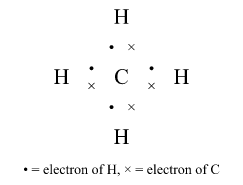 Carbon shares its four valence electrons with four hydrogen atoms. It has four single covalent bonds.(ii) Two fuels containing methane as an important component: biogas and compressed natural gas (CNG).(iii) Homologous series: alkanes. General formula: (iv) Methane is a saturated hydrocarbon, so it burns with a clean blue flame (non-sooty).
© examsnet.com
Go to Question: