Test Index
Carbon and its Compounds
Carbon and its Compounds

 CBSE Board Videos
© examsnet.com
Question : 27 of 35
Marks:
+1,
-0
(a) Explain why carbon forms compounds mainly by covalent bonds. Explain in brief two main reasons for carbon forming a large number of compounds. Why does carbon form strong bonds with most other elements ?OR(b) (i) Write the name and general formula of a chain of hydrocarbons in which an addition reaction with hydrogen can take place. Stating the essential condition required for an addition reaction to occur, write the chemical equation giving the name of the reactant and product of such a reaction. How is an addition reaction different from a substitution reaction ?(ii) Write the structure of benzene.
[CBSE 2023 31/5/3]
Solution:
(a)Covalent bonding: Carbon (atomic number 6, configuration 2, 4) has 4 electrons in its outermost shell. To reach a noble gas configuration it would have to gain 4 electrons (forming ) or lose 4 electrons (forming ).Gaining 4 electrons is difficult, because a nucleus with 6 protons cannot hold 10 electrons. Losing 4 electrons needs a large amount of energy, and the ion with 6 protons holding only 2 electrons would not be stable. So carbon shares its valence electrons with other atoms and forms covalent bonds.Two reasons for the large number of carbon compounds:1. Catenation: Carbon has the unique ability to form bonds with other carbon atoms, giving long chains, branched chains and rings, with single, double or triple bonds.2. Tetravalency: With a valency of 4, carbon can bond with four other atoms, of carbon or of other elements such as hydrogen, oxygen, nitrogen, sulphur and chlorine. This gives compounds with different properties.Strong bonds: Carbon atoms are small. The nucleus can hold the shared pairs of electrons strongly, so the bonds carbon forms with most other elements are very strong and its compounds are stable.OR (b)(i) Unsaturated hydrocarbons: alkenes, general formula (also alkynes, ).Essential condition: the presence of a catalyst such as nickel or palladium (with heat).Reactant: ethene; product: ethane. (This reaction is used in the hydrogenation of vegetable oils.)Addition vs substitution: In an addition reaction, atoms add across the double or triple bond of an unsaturated hydrocarbon, converting it into a saturated compound. In a substitution reaction, one atom or group of atoms in a saturated hydrocarbon replaces a hydrogen atom (e.g. ).(ii) Structure of benzene (): a ring of six carbon atoms with alternate single and double bonds, and one hydrogen on each carbon.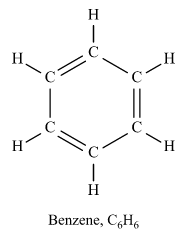
© examsnet.com
Go to Question: