Test Index
Carbon and its Compounds
Carbon and its Compounds

 CBSE Board Videos
© examsnet.com
Question : 25 of 35
Marks:
+1,
-0
(A) (i) It is observed that covalent compounds are bad conductors of electricity. Give reason.(ii) Carbon can neither form cation nor anion. Why ?(iii) Draw electron dot structure of Ethanol.(iv) Identify hetero atom(s) in the following compounds :(a) (b) OR(B) (i) What are soaps ? Explain the mechanism of cleansing action of soap with the help of a labelled diagram.(ii) Detergents are better than soaps. Justify.
[CBSE 2023 31/4/2]
Solution:
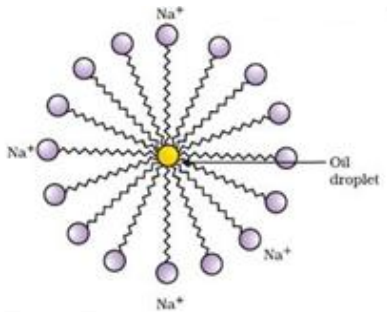
(A)(i) Covalent compounds are formed by sharing of electrons; they have no free ions (or free electrons) to carry charge. So they are bad conductors of electricity.(ii) Carbon (2, 4) has 4 valence electrons.: losing four electrons would need a very large amount of energy, so the cation is not formed.: gaining four electrons would be difficult because a nucleus with only six protons cannot hold ten electrons (in a small atom). So carbon completes its octet by sharing electrons (covalent bonds).(iii) Electron dot structure of ethanol ():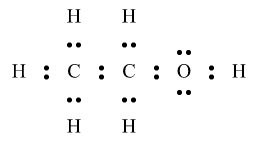 Each pair of dots between two atoms is one shared pair (single bond); oxygen also has two lone pairs.(iv) An atom other than carbon and hydrogen that replaces hydrogen in a hydrocarbon chain is a heteroatom.(a) (butanone): heteroatom is oxygen.(b) (chloroethane): heteroatom is chlorine.OR (B)(i) Soaps are sodium or potassium salts of long-chain carboxylic acids (fatty acids), e.g. .Cleansing action: A soap molecule has two ends: an ionic end () that is hydrophilic (dissolves in water) and a long hydrocarbon tail that is hydrophobic (dissolves in oil). Most dirt is oily. In water, soap molecules arrange themselves in clusters called micelles: the hydrocarbon tails point inwards into the oily dirt and the ionic ends face outwards towards the water. The oily dirt is thus collected in the centre of the micelle. The micelles stay in solution as a colloid (emulsion) and do not come together because of ion-ion repulsion. Rinsing with water washes the micelles, and the dirt in them, away.
 (ii) Detergents are better cleansing agents than soaps because they do not form insoluble precipitates (scum) with the calcium and magnesium ions of hard water, so they work well even in hard water.
© examsnet.com
Go to Question: