Test Index
Carbon and its Compounds
Carbon and its Compounds

 CBSE Board Videos
© examsnet.com
Question : 23 of 35
Marks:
+1,
-0
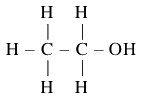
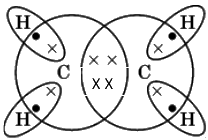
(A) (i) Define a homologous series of carbon compounds.(ii) Why is the melting and boiling points of higher than that of or ?(iii) Why do we NOT see any gradation in chemical properties of a homologous series compounds ?(iv) Write the name and structures of (i) aldehyde and (ii) ketone with molecular form .OR(B) (i) Write the name and structure of an organic compound ‘X’ having two carbon atoms in its molecule and its name is suffixed with ‘–ol’.(ii) What happens when ‘X’ is heated with excess concentrated sulphuric acid at 443 K? Write chemical equation for the reaction stating the conditions for the reaction. Also state the role played by concentrated sulphuric acid in the reaction.(iii) Name and draw the electron dot structure of hydrocarbon produced in the above reaction.
[CBSE 2024 31/1/1]
Solution:
(A)(i) A homologous series is a series of carbon compounds in which the same functional group substitutes for hydrogen in a carbon chain. Successive members differ by a unit (14 u in mass) and have similar chemical properties.(ii) , and are members of the same homologous series (alkenes). As the molecular mass increases ( u is the heaviest), the melting and boiling points increase. So has the highest melting and boiling points.(iii) Chemical properties are decided by the functional group. All members of a homologous series have the same functional group, so their chemical properties are similar and show no gradation (only physical properties change gradually).(iv) Molecular formula :Aldehyde: propanal, 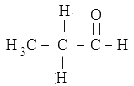 Ketone: propanone (acetone),
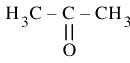 OR (B)(i) X is ethanol, ():
 (ii) On heating with excess concentrated sulphuric acid at 443 K, ethanol is dehydrated to ethene:Conditions: excess concentrated sulphuric acid, heated to 443 K.Role of concentrated sulphuric acid: it acts as a dehydrating agent and removes water from ethanol.(iii) The hydrocarbon formed is ethene, . Electron dot structure (a double bond: two shared electron pairs between the carbon atoms):
© examsnet.com
Go to Question: