Test Index
Carbon and its Compounds
Carbon and its Compounds

 CBSE Board Videos
© examsnet.com
Question : 2 of 35
Marks:
+1,
-0
Attempt either (a) or (b):(a) A carbon compound 'P' of molecular formula is found to be neutral when tested with red and blue litmus. A gas that burns with a pop sound is produced when sodium metal reacts with compound 'P'.(i) Identify the compound 'P'.(ii) The carbon compound 'P' is heated with conc. at 443 K to produce compound 'Q'.(I) Write the chemical equation for the reaction.(II) What is the role of conc. in this reaction?(iii) What is likely to be observed on heating compound 'P' with ethanoic acid with an acid as a catalyst? Write the chemical equation for the reaction.OR(b) (i) Write the structural formula of benzene.(ii) State the reason why carbon can neither form cation nor anion.(iii) What type of bond is formed between carbon and hydrogen?(iv) How is ethanol converted to ethanoic acid?(v) Complete the following chemical equation:
[CBSE 2026 31/2/1]
Solution:
(a)(i)P is ethanol, (). It is neutral to litmus, and with sodium it gives hydrogen gas (pop sound):(a)(ii)(I) Ethanol is dehydrated to ethene (Q):(II) Concentrated sulphuric acid acts as a dehydrating agent: it removes a molecule of water from ethanol.(a)(iii)A sweet-smelling substance, an ester (ethyl ethanoate), is formed. This reaction is called esterification.OR (b)(b)(i)Benzene, : a ring of six carbon atoms with alternate single and double bonds and one hydrogen on each carbon.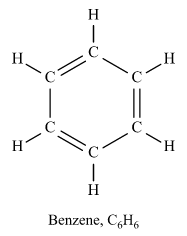 (b)(ii)Carbon (2, 4) has four valence electrons.To form it would have to lose four electrons, which needs a very large amount of energy.To form it would have to gain four electrons, and a nucleus with only six protons cannot hold ten electrons.So carbon completes its octet by sharing electrons (covalent bonding).(b)(iii)A covalent bond (a single covalent bond formed by sharing one pair of electrons between C and H).(b)(iv)By oxidation: ethanol is heated with an oxidising agent such as alkaline potassium permanganate or acidified potassium dichromate.(b)(v)The ester is hydrolysed by the base (saponification) to sodium ethanoate and ethanol:
© examsnet.com
Go to Question: