Test Index
Carbon and its Compounds
Carbon and its Compounds

 CBSE Board Videos
© examsnet.com
Question : 12 of 35
Marks:
+1,
-0
(a) (i) Draw two isomeric structures of Butene ().(ii) Name the following compounds :(I)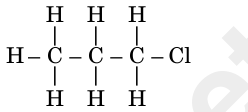 (II)
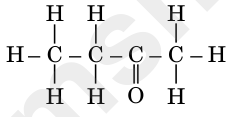 (iii) Write the chemical equations for the following reactions. Mention one essential condition each for these reactions to take place.(I) Ethanol undergoes complete oxidation(II) Propene undergoes hydrogenation(III) Ethanoic acid reacts with ethanolOR(b) (i) A carbon compound X is a good solvent. On reaction with sodium, X forms two products Y and Z. Z is used to convert vegetable oil into vegetable ghee. Identify and name X, Y and Z. Also write the equation of reaction of X with sodium to justify your answer.(ii) Write chemical equation to show what happens when ethanol :(I) burns in oxygen/air.(II) is heated at 443 K in excess conc. .(III) reacts with acidified potassium dichromate.
[CBSE 2025 31/1/1]
Solution:
(a)(i)Butene, , is an alkene with one C=C double bond. Its isomers differ in the position of the double bond or in the carbon chain:1. But-1-ene: 2. But-2-ene: 3. 2-Methylpropene: (branched chain)Any two of these are isomers: same molecular formula , different structures.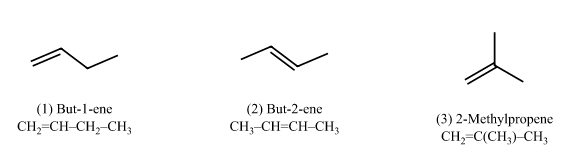 (a)(ii)(I) : three carbons (prop-), all single bonds (-ane), chloro group at the end: Chloropropane (1-chloropropane).(II) : four carbons (but-), ketone group C=O on carbon 2 (-one): Butanone (butan-2-one).(a)(iii)(I) Oxidation of ethanol to ethanoic acid. Condition: an oxidising agent, alkaline potassium permanganate (or acidified potassium dichromate), and heating.(II) Hydrogenation (addition of hydrogen). Condition: a catalyst such as nickel (or palladium). (propane)(III) Esterification. Condition: a few drops of concentrated sulphuric acid (acid catalyst) and warming. (ethyl ethanoate, a sweet-smelling ester)OR (b)(i)Z is used to convert vegetable oil into vegetable ghee (hydrogenation), so Z is hydrogen gas. A good solvent that gives hydrogen with sodium is ethanol.X = Ethanol, Y = Sodium ethoxide, Z = Hydrogen, (b)(ii)(I) Combustion: + heat and light (clean blue flame).(II) Dehydration to ethene: Conc. acts as a dehydrating agent, removing water from ethanol.(III) Oxidation to ethanoic acid: The orange dichromate solution turns green as it oxidises ethanol.
© examsnet.com
Go to Question: