Test Index
Acids, Bases and Salts
Acids, Bases and Salts

 CBSE Board Videos
© examsnet.com
Question : 4 of 68
Marks:
+1,
-0
Read the following passage and answer the questions that follow:In the given diagram, when electricity is passed through an aqueous solution of a common salt, a substance 'Z' is produced, along with the evolution of gases 'X' and 'Y'. When a burning matchstick is brought near the gas 'Y', it burns with a pop sound, whereas 'X' is used for disinfecting drinking water. When 'X' is passed through slaked lime, an insoluble substance 'A' is produced.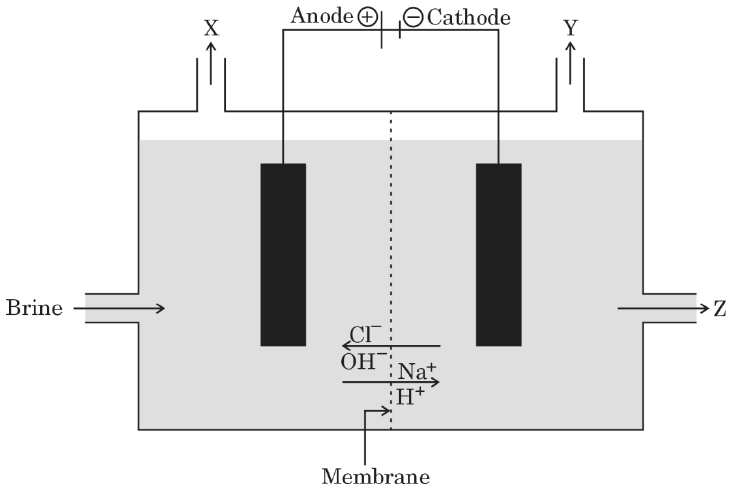 (a) Write the names of the gases 'X' and 'Y'. (1)(b) Write the balanced chemical equation for the formation of substance 'Z'. (1)(c) (i) What happens: (2)(I) If a drop of red litmus solution is added to the aqueous solution of substance 'Z'?(II) If gas is passed through ammoniacal solution of aqueous NaCl?OR(c) (ii) Identify the substance 'A' and write the balanced chemical equation of the reaction which takes place in its preparation. (2)
[CBSE 2026 31/2/1]
Solution:
(a)This is the chlor-alkali process (electrolysis of brine).X = chlorine gas (), given off at the anode; it is used to disinfect drinking water.Y = hydrogen gas (), given off at the cathode; it burns with a pop sound.(b)Z is sodium hydroxide, formed near the cathode:(c)(i)(I) Sodium hydroxide is a base (alkali), so the red litmus solution turns blue.(II) Sodium hydrogen carbonate (baking soda) and ammonium chloride are formed; sodium hydrogen carbonate, being sparingly soluble, separates out:OR (c)(ii)A is bleaching powder, calcium oxychloride (). It is made by passing chlorine over dry slaked lime:
© examsnet.com
Go to Question: