Test Index
Acids, Bases and Salts
Acids, Bases and Salts

 CBSE Board Videos
© examsnet.com
Question : 15 of 68
Marks:
+1,
-0
(a) Common salt is an important raw material for various chemicals of daily use. State in brief the method of preparation of (i) Sodium hydroxide, and (ii) Sodium hydrogen carbonate from common salt. Write balanced chemical equations of the reactions that occur.OR(b) Design an experimental set-up to demonstrate that “Alcohol and glucose contain hydrogen but are not categorised as acids”. Also give the reason to justify this fact.
[CBSE 2025 31/3/2]
Solution:
(a)(i) Sodium hydroxide (chlor-alkali process):Electricity is passed through brine (a concentrated aqueous solution of sodium chloride). Chlorine gas is given off at the anode, hydrogen gas at the cathode, and sodium hydroxide solution forms near the cathode.(a)(ii) Sodium hydrogen carbonate:Carbon dioxide is passed through a cold solution of sodium chloride saturated with ammonia. Sodium hydrogen carbonate, being less soluble, separates out.OR (b)Set-up:1. Fix two iron nails on a rubber cork and place the cork in a beaker.2. Connect the nails through a bulb and a switch to a battery.3. Pour a solution of glucose in water into the beaker and switch on the current. Repeat with an alcohol solution, and then with dilute .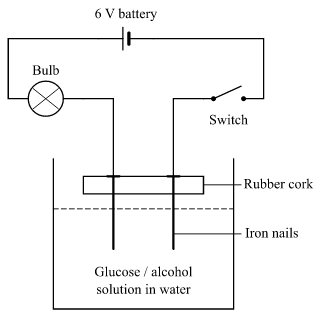 Observation: The bulb glows with dilute but does not glow with the glucose or alcohol solution.Reason: An acid gives ions in water, and these ions carry the current. Glucose and alcohol contain hydrogen, but it is not released as ions in water (they do not ionise), so their solutions do not conduct electricity. Hence they are not categorised as acids.
© examsnet.com
Go to Question: