Test Index
CBSE Class 10 Science 2023 Outside Delhi Set 3
© examsnet.com
Question : 12 of 12
Marks:
+1,
-0
(a) Name the two types of pollination and differentiate between them.(b) Explain the post fertilization changes that occur in the ovary of a flower.(c) Given below is a diagram of a germinating seed. Label the parts that(i) gives rise to future shoot.(ii) gives rise to future root system.(iii) stores food. 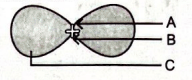
Solution:
(a) There are two types of pollination self-pollination and cross-pollination.The difference between self-pollination and cross-pollination are given below:
(b) Fertilization is the process of fusion of the female gamete (ovum or egg) and the male gamete produced in the pollen tube by the pollen grains. Post- fertilization the ovary develops into the fruit while the ovary wall develops into pericarp.(c) (i) A: Plumule is the young shoot of a plant embryo above the cotyledons, consisting of the epicotyl and often of immature leaves.(ii) : Radicle is the first part of a seedling to emerge from the seed during the process of germination. The radicle is the embryonic root of the plant and grows downward in the soil.(iii) C: Cotyledon is the significant part of the embryo within the seed of a plant. Upon germination, the cotyledon may become the embryonic first leaves of a seedling.
| Self-pollination | Cross-pollination |
|---|---|
| The process of transfer of pollen grains from anthers to the stigma of a flower, but when this process is between the flowers of the same plant than the process is called selfpollination. | The process of transfer of pollen grains between the flowers of the different plants of the same species is called cross-pollination. |
| It involves single plant | Involves two different plants of the same species. |
| It occurs in perfect flowers only. | It occurs in both imperfect and perfect flowers. |
| Pollinating agents are not required. | Pollinating agent such as wind, water, insects, etc. are required. |
© examsnet.com
Go to Question: