Test Index
CBSE Class 10 Science 2023 Outside Delhi Set 1
© examsnet.com
Question : 34 of 39
Marks:
+1,
-0
(a) (i) A compound 'A' with a molecular formula of reacts with a base to give salt and water. Identify ' ', state its nature and the name of the functional group it possesses. Write chemical equation for the reaction involved.(ii) When the above stated compound ' ' reacts with another compound ' ' having molecular formula in the presence of an acid, a sweet smelling compound is ' ' formed.(1) Identify ' ' and ' '(2) State the role of acid in this reaction.(3) Write chemical equation for the reaction involved ORb) (i) Name the compound formed when ethanol is heated at in the presence of conc. and draw its electron dot structure.State the role of conc. in this reaction.(ii) What is hydrogenation? Explain it with the help of a chemical equation. State the role of this reaction in industry.
Solution:
(a) (i) Since,As we know that, acid reacts with base to give salt and water Compound will be acidic in nature with carboxylic acid group.Chemical equation for acid and base reaction: Thus, Compound 'A is it is acidic in nature containing a carboxyl functional group.(ii) Carboxylic acids can react with alcohols to form esters in a process called Fischer esterification. An acid catalyst is required and the alcohol is also used as the reaction solvent.(1) Compound B is Ethanol and C is Ethyl acetate.(2) act as catalyst.(3) A sweet-smelling compound formed by reacting acetic acid with ethanol in the presence of hydrochloric acid is ethyl acetate. OR(b) (i) Ethene is formed when ethanol at is heated with excess concentrated sulphuric acid.The mechanism of acid dehydration of ethanol to yield ethene is:1. First step is the protonation of oxygen atom of -OH group.2. Second step is the loss of a molecule of water to form carbonium ion.3. Last step is deprotonation to form carbon- carbon double bond. 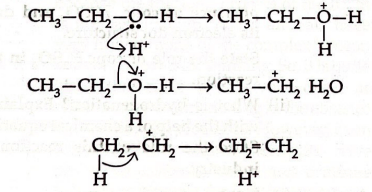 Concentrated sulphuric acid can act as a dehydrating agent. Hence, ethanol when heated at with excess conc. undergoes dehydration reaction to form ethene.(ii) Hydrogenation is the process of addition between hydrogen and other compounds in presence of a catalyst.For example: Alkene can be converted to alkane by using in presence of metal catalyst such as or The industrial applications are as follows:1. To convert alkenes into alkanes.2. To prepare vegetable ghee from vegetable oils.
© examsnet.com
Go to Question: