Test Index
CBSE Class 10 Science 2020 Outside Delhi Set 2
© examsnet.com
Question : 5 of 7
Marks:
+1,
-0
(a) Carry out following conversions :(i) Ethanol to Ethene(ii) Ethanol to Ethanoic acid(b) Differentiate between addition reaction and substitution reaction. Give one example of each.
Solution:
(a) (i) Conversion of ethanol to ethene: Heating ethanol at with excess concentrated sulphuric acid results in the dehydration of ethanol to give ethene. The concentrated sulphuric acid can be regarded as a dehydrating agent which removes water from ethanol.(ii) Conversion of ethanol to ethanoic acid:Ethanol can be converted to ethanoic acid in the presence of alkaline and by heating the solution to give the ethanoic acid. (b) Difference between addition and substitution reaction :
Example of addition reaction :Addition reaction is commonly used in the hydrogenation of vegetable oils using a nickel catalyst. Vegetable oils generally have long unsaturated carbon chains while animal fats have saturated carbon chains.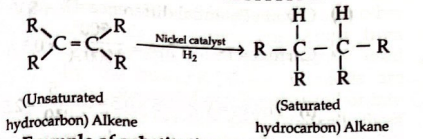 Example of substitution reaction:In the presence of sunlight, chlorine is added to hydrocarbons in a very fast reaction. Chlorine can replace the hydrogen atoms one by one. Thus these reactions are used in the synthesis of the intermediates.
| S.No | Addition reaction | Substitution reaction |
|---|---|---|
| 1 | It is the combination of two or more atoms or molecules in order to form a large molecule. | The large molecules formed after the reaction is called the adduct. |
| 2 | The large molecules formed after the reaction is called the adduct. | The leaving group or the molecular components which leave the reaction and are being replaced are called substrates. |
| 3 | No by-product is formed. | A by-product is formed. |
© examsnet.com
Go to Question: