Test Index
Triangles
Triangles

 CBSE Board Videos
© examsnet.com
Question : 8 of 83
Marks:
+1,
-0
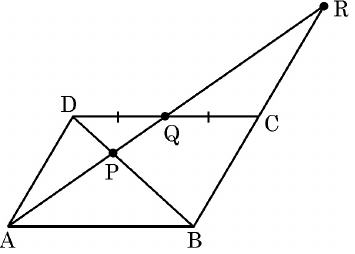
(a) D is the mid-point of side BC of . CE and BF intersect at O, a point on AD. AD is produced to G such that OD = DG. Prove that(i) OBGC is a parallelogram.(ii) (iii) 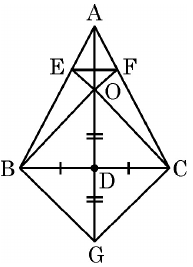 OR(b) Through the mid-point Q of side CD of a parallelogram ABCD, the line AR is drawn which intersects BD at P and produced BC at R. Prove that(i) AQ = QR(ii) AP = 2PQ(iii) PR = 2AP
[CBSE 2026 Standard 30/5/3]
Solution:
(a)Given: D is the mid-point of BC, CE and BF meet at O on AD, and OD = DG.(i) In quadrilateral OBGC, the diagonals are OG and BC.BD = DC (D is the mid-point of BC) and OD = DG (given).So the diagonals OG and BC bisect each other at D.A quadrilateral whose diagonals bisect each other is a parallelogram. Hence OBGC is a parallelogram.(ii) Since OBGC is a parallelogram, and .E lies on CO produced and F lies on BO produced, so and .In , . By the Basic Proportionality Theorem (BPT), ...(1)In , . By BPT, ...(2)From (1) and (2), .So in , the line EF divides AB and AC in the same ratio. By the converse of BPT, .(iii) In and : (common) (corresponding angles, )So by AA similarity, .OR (b)Given: ABCD is a parallelogram, Q is the mid-point of CD, AQ produced meets BC produced at R, and AR cuts BD at P.(i) In and :DQ = CQ (Q is the mid-point of CD) (vertically opposite angles) (alternate angles, with transversal DC)So (ASA), and hence AQ = QR (CPCT).(ii) In and : (vertically opposite angles) (alternate angles, )So (AA), which givesBut , so .Hence , i.e. AP = 2PQ.(iii) PR = PQ + QR= PQ + AQ (from (i), QR = AQ)= PQ + (AP + PQ) = AP + 2PQ= AP + AP (from (ii), 2PQ = AP)= 2APHence PR = 2AP.
© examsnet.com
Go to Question: