© examsnet.com
Question : 63 of 83
Marks: +1, -0
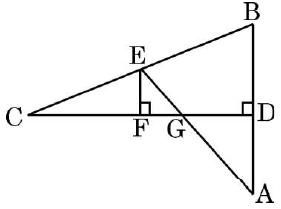
(a) In the given figure, CD is the perpendicular bisector of AB. EF is perpendicular to CD. AE intersects CD at G. Prove that CFCD=FGDG\dfrac{CF}{CD} = \dfrac{FG}{DG}.
OR
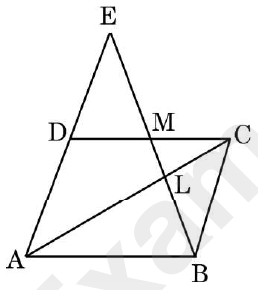
(b) In the given figure, ABCD is a parallelogram. BE bisects CD at M and intersects AC at L. Prove that EL=2BLEL = 2BL.
[CBSE 2023 Standard 30/5/1]
Solution:  
(a)
CD is the perpendicular bisector of AB, so AD=BDAD = BD and ∠CDB=∠GDA=90∘\angle CDB = \angle GDA = 90^\circ. Also ∠EFC=∠EFG=90∘\angle EFC = \angle EFG = 90^\circ.
In ΔEFG\Delta EFG and ΔADG\Delta ADG: ∠EFG=∠ADG=90∘\angle EFG = \angle ADG = 90^\circ, ∠EGF=∠AGD\angle EGF = \angle AGD (vertically opposite).
So ΔEFG∼ΔADG\Delta EFG \sim \Delta ADG (AA) ⇒EFAD=FGDG\Rightarrow \dfrac{EF}{AD} = \dfrac{FG}{DG} ...(1)
In ΔEFC\Delta EFC and ΔBDC\Delta BDC: ∠EFC=∠BDC=90∘\angle EFC = \angle BDC = 90^\circ, ∠C\angle C is common.
So ΔEFC∼ΔBDC\Delta EFC \sim \Delta BDC (AA) ⇒EFBD=CFCD\Rightarrow \dfrac{EF}{BD} = \dfrac{CF}{CD}
Since BD=ADBD = AD: EFAD=CFCD\dfrac{EF}{AD} = \dfrac{CF}{CD} ...(2)
From (1) and (2): CFCD=FGDG\dfrac{CF}{CD} = \dfrac{FG}{DG}
Hence proved.
OR (b)
E lies on AD produced, so AE∥BCAE \parallel BC; and AB∥DCAB \parallel DC.
In ΔALE\Delta ALE and ΔCLB\Delta CLB: ∠ALE=∠CLB\angle ALE = \angle CLB (vertically opposite), ∠LAE=∠LCB\angle LAE = \angle LCB (alternate angles, AE∥BCAE \parallel BC).
So ΔALE∼ΔCLB\Delta ALE \sim \Delta CLB (AA) ⇒ALCL=ELBL\Rightarrow \dfrac{AL}{CL} = \dfrac{EL}{BL} ...(1)
In ΔCLM\Delta CLM and ΔALB\Delta ALB: ∠CLM=∠ALB\angle CLM = \angle ALB (vertically opposite), ∠LCM=∠LAB\angle LCM = \angle LAB (alternate angles, CD∥ABCD \parallel AB).
So ΔCLM∼ΔALB\Delta CLM \sim \Delta ALB (AA) ⇒ALCL=ABCM\Rightarrow \dfrac{AL}{CL} = \dfrac{AB}{CM}
AB=CD=2CMAB = CD = 2CM (M is the mid-point of CD), so ALCL=2CMCM=2\dfrac{AL}{CL} = \dfrac{2CM}{CM} = 2 ...(2)
From (1) and (2): ELBL=2⇒EL=2BL\dfrac{EL}{BL} = 2 \Rightarrow EL = 2BL
Hence proved.
© examsnet.com
Advertisements
Go to Question: