© examsnet.com
Question : 60 of 83
Marks: +1, -0
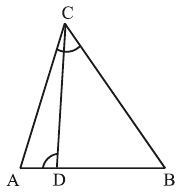
(A) In the given figure, ∠ADC=∠BCA\angle ADC = \angle BCA ; prove that ΔACB∼ΔADC\Delta ACB \sim \Delta ADC. Hence find BD if AC=8AC = 8 cm and AD=3AD = 3 cm.
OR
(B) If a line is drawn parallel to one side of a triangle to intersect the other two sides in distinct points, then prove that the other two sides are divided in the same ratio.
[CBSE 2023 Standard 30/4/2]
Solution:  
(A)
In ΔACB\Delta ACB and ΔADC\Delta ADC:
∠BCA=∠ADC\angle BCA = \angle ADC (given)
∠CAB=∠DAC\angle CAB = \angle DAC (common angle A)
So ΔACB∼ΔADC\Delta ACB \sim \Delta ADC (AA similarity criterion).
Corresponding sides are proportional: ACAD=ABAC\dfrac{AC}{AD} = \dfrac{AB}{AC}
83=AB8⇒AB=643\dfrac{8}{3} = \dfrac{AB}{8} \Rightarrow AB = \dfrac{64}{3} cm
BD=AB−AD=643−3=553BD = AB - AD = \dfrac{64}{3} - 3 = \dfrac{55}{3} cm
Result: BD=553BD = \dfrac{55}{3} cm ≈18.33\approx 18.33 cm
OR (B) (Basic Proportionality Theorem)
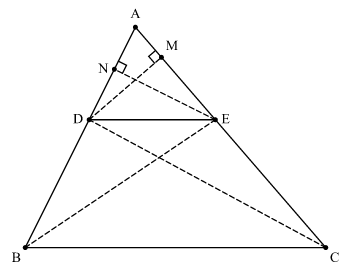
Given: In ΔABC\Delta ABC, a line parallel to BC meets AB at D and AC at E, so DE∥BCDE \parallel BC.
To prove: ADDB=AEEC\dfrac{AD}{DB} = \dfrac{AE}{EC}
Construction: Join BE and CD. Draw EN⊥ABEN \perp AB and DM⊥ACDM \perp AC.
Proof:
ar(ΔADE)=12×AD×EN\text{ar}(\Delta ADE) = \dfrac{1}{2} \times AD \times EN and ar(ΔBDE)=12×DB×EN\text{ar}(\Delta BDE) = \dfrac{1}{2} \times DB \times EN
So ar(ΔADE)ar(ΔBDE)=ADDB\dfrac{\text{ar}(\Delta ADE)}{\text{ar}(\Delta BDE)} = \dfrac{AD}{DB} ...(1)
ar(ΔADE)=12×AE×DM\text{ar}(\Delta ADE) = \dfrac{1}{2} \times AE \times DM and ar(ΔDEC)=12×EC×DM\text{ar}(\Delta DEC) = \dfrac{1}{2} \times EC \times DM
So ar(ΔADE)ar(ΔDEC)=AEEC\dfrac{\text{ar}(\Delta ADE)}{\text{ar}(\Delta DEC)} = \dfrac{AE}{EC} ...(2)
ΔBDE\Delta BDE and ΔDEC\Delta DEC stand on the same base DE and lie between the same parallels DE and BC, so
ar(ΔBDE)=ar(ΔDEC)\text{ar}(\Delta BDE) = \text{ar}(\Delta DEC) ...(3)
From (1), (2) and (3): ADDB=AEEC\dfrac{AD}{DB} = \dfrac{AE}{EC}. Hence proved.
© examsnet.com
Advertisements
Go to Question: