© examsnet.com
Question : 53 of 83
Marks: +1, -0
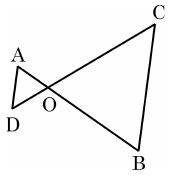
(a) In the given figure, OA⋅OB=OC⋅ODOA \cdot OB = OC \cdot OD. Prove that △AOD∼△COB\triangle AOD \sim \triangle COB.
OR
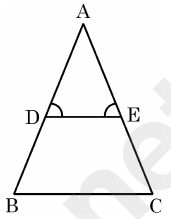
(b) In the given figure, ∠D=∠E\angle D = \angle E and ADDB=AEEC\dfrac{AD}{DB} = \dfrac{AE}{EC}. Prove that △ABC\triangle ABC is isosceles.
[CBSE 2024 Basic 430/2/3]
Solution:  
(a)
Given OA⋅OB=OC⋅ODOA \cdot OB = OC \cdot OD
⇒OAOC=ODOB\Rightarrow \dfrac{OA}{OC} = \dfrac{OD}{OB} ...(1)
In △AOD\triangle AOD and △COB\triangle COB:
OAOC=ODOB\dfrac{OA}{OC} = \dfrac{OD}{OB} (from (1))
∠AOD=∠COB\angle AOD = \angle COB (vertically opposite angles)
So △AOD∼△COB\triangle AOD \sim \triangle COB (SAS similarity criterion).
OR (b)
Given ADDB=AEEC\dfrac{AD}{DB} = \dfrac{AE}{EC}, so by the converse of the Basic Proportionality Theorem, DE∥BCDE \parallel BC.
With transversal AB: ∠ADE=∠ABC\angle ADE = \angle ABC (corresponding angles)
With transversal AC: ∠AED=∠ACB\angle AED = \angle ACB (corresponding angles)
But ∠ADE=∠AED\angle ADE = \angle AED (given)
⇒∠ABC=∠ACB\Rightarrow \angle ABC = \angle ACB
⇒AC=AB\Rightarrow AC = AB (sides opposite to equal angles of a triangle are equal)
Hence △ABC\triangle ABC is isosceles.
© examsnet.com
Advertisements
Go to Question: