© examsnet.com
Question : 51 of 83
Marks: +1, -0
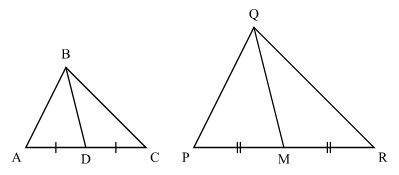
(a) If BD and QM are medians of triangles ABC and PQR, respectively, where ΔABC∼ΔPQR\Delta ABC \sim \Delta PQR, prove that ABPQ=BDQM\dfrac{AB}{PQ} = \dfrac{BD}{QM}.
OR
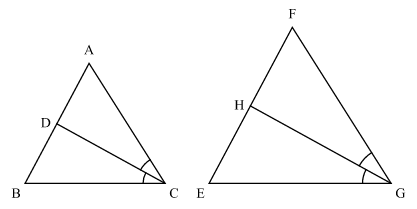
(b) CD and GH are respectively the bisectors of ∠ACB\angle ACB and ∠EGF\angle EGF such that D and H lie on sides AB and FE of ΔABC\Delta ABC and ΔFEG\Delta FEG respectively. If ΔABC∼ΔFEG\Delta ABC \sim \Delta FEG, show that :
(i) CDGH=ACFG\dfrac{CD}{GH} = \dfrac{AC}{FG}
(ii) ΔDCB∼ΔHGE\Delta DCB \sim \Delta HGE
[CBSE 2024 Basic 430/4/1]
Solution:  
(a)
Given: ΔABC∼ΔPQR\Delta ABC \sim \Delta PQR; BD and QM are medians, so D is the mid-point of AC and M is the mid-point of PR.
To prove: ABPQ=BDQM\dfrac{AB}{PQ} = \dfrac{BD}{QM}
Proof:
Since ΔABC∼ΔPQR\Delta ABC \sim \Delta PQR:
ABPQ=ACPR\dfrac{AB}{PQ} = \dfrac{AC}{PR} ...(i) and ∠A=∠P\angle A = \angle P ...(ii)
As AC=2ADAC = 2AD and PR=2PMPR = 2PM:
ABPQ=2AD2PM=ADPM\dfrac{AB}{PQ} = \dfrac{2AD}{2PM} = \dfrac{AD}{PM} ...(iii)
In △ABD\triangle ABD and △PQM\triangle PQM:
ABPQ=ADPM\dfrac{AB}{PQ} = \dfrac{AD}{PM} (from (iii))
∠A=∠P\angle A = \angle P (from (ii))
∴△ABD∼△PQM\therefore \triangle ABD \sim \triangle PQM (SAS similarity criterion)
So ABPQ=BDQM\dfrac{AB}{PQ} = \dfrac{BD}{QM} (corresponding sides of similar triangles). Hence proved.
OR (b)
Given: ΔABC∼ΔFEG\Delta ABC \sim \Delta FEG; CD bisects ∠ACB\angle ACB (D on AB) and GH bisects ∠EGF\angle EGF (H on FE).
From ΔABC∼ΔFEG\Delta ABC \sim \Delta FEG: ∠A=∠F\angle A = \angle F, ∠B=∠E\angle B = \angle E and ∠ACB=∠FGE\angle ACB = \angle FGE.
Halving the equal angles ∠ACB\angle ACB and ∠FGE\angle FGE:
∠ACD=∠FGH\angle ACD = \angle FGH and ∠DCB=∠HGE\angle DCB = \angle HGE ...(1)
(i) In △ACD\triangle ACD and △FGH\triangle FGH:
∠A=∠F\angle A = \angle F
∠ACD=∠FGH\angle ACD = \angle FGH (from (1))
∴△ACD∼△FGH\therefore \triangle ACD \sim \triangle FGH (AA similarity criterion)
∴CDGH=ACFG\therefore \dfrac{CD}{GH} = \dfrac{AC}{FG}. Hence proved.
(ii) In △DCB\triangle DCB and △HGE\triangle HGE:
∠B=∠E\angle B = \angle E
∠DCB=∠HGE\angle DCB = \angle HGE (from (1))
∴△DCB∼△HGE\therefore \triangle DCB \sim \triangle HGE (AA similarity criterion). Hence proved.
© examsnet.com
Advertisements
Go to Question: