© examsnet.com
Question : 45 of 83
Marks: +1, -0
(a) If a line is drawn parallel to one side of a triangle to intersect the other two sides in distinct points, then prove that the other two sides are divided in the same ratio.
OR
(b) Sides AB and AC and median AD to ΔABC\Delta ABC are respectively proportional to sides PQ and PR and median PM of another triangle PQR. Show that ΔABC∼ΔPQR\Delta ABC \sim \Delta PQR.
[CBSE 2024 Standard 30/2/3]
Solution:  
(a) (Basic Proportionality Theorem)
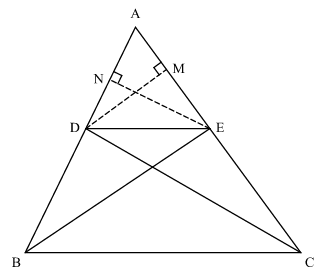
Given: In ΔABC\Delta ABC, a line DE∥BCDE \parallel BC meets AB at D and AC at E.
To prove: ADDB=AEEC\dfrac{AD}{DB} = \dfrac{AE}{EC}
Construction: Join BE and CD. Draw EN⊥ABEN \perp AB and DM⊥ACDM \perp AC.
Proof:
ar(ΔADE)=12×AD×EN\text{ar}(\Delta ADE) = \dfrac{1}{2} \times AD \times EN, ar(ΔBDE)=12×DB×EN\text{ar}(\Delta BDE) = \dfrac{1}{2} \times DB \times EN
⇒ar(ΔADE)ar(ΔBDE)=ADDB\Rightarrow \dfrac{\text{ar}(\Delta ADE)}{\text{ar}(\Delta BDE)} = \dfrac{AD}{DB} ...(1)
ar(ΔADE)=12×AE×DM\text{ar}(\Delta ADE) = \dfrac{1}{2} \times AE \times DM, ar(ΔDEC)=12×EC×DM\text{ar}(\Delta DEC) = \dfrac{1}{2} \times EC \times DM
⇒ar(ΔADE)ar(ΔDEC)=AEEC\Rightarrow \dfrac{\text{ar}(\Delta ADE)}{\text{ar}(\Delta DEC)} = \dfrac{AE}{EC} ...(2)
ΔBDE\Delta BDE and ΔDEC\Delta DEC are on the same base DE and between the same parallels DE and BC, so
ar(ΔBDE)=ar(ΔDEC)\text{ar}(\Delta BDE) = \text{ar}(\Delta DEC) ...(3)
From (1), (2) and (3): ADDB=AEEC\dfrac{AD}{DB} = \dfrac{AE}{EC}
Hence the other two sides are divided in the same ratio.
OR (b)
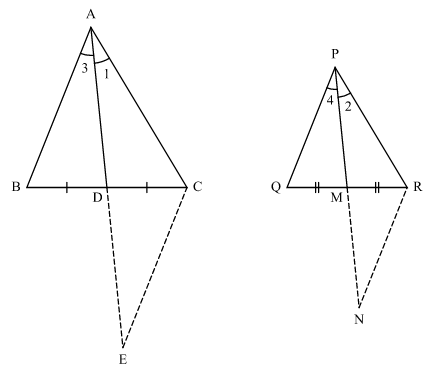
Given: AD and PM are medians of ΔABC\Delta ABC and ΔPQR\Delta PQR, and ABPQ=ACPR=ADPM\dfrac{AB}{PQ} = \dfrac{AC}{PR} = \dfrac{AD}{PM}.
To prove: ΔABC∼ΔPQR\Delta ABC \sim \Delta PQR
Construction: Produce AD to E so that DE=ADDE = AD and join EC. Produce PM to N so that MN=PMMN = PM and join NR.
Proof:
In ΔADB\Delta ADB and ΔEDC\Delta EDC: AD=EDAD = ED, BD=CDBD = CD (D is the mid-point of BC), ∠ADB=∠EDC\angle ADB = \angle EDC (vertically opposite).
So ΔADB≅ΔEDC\Delta ADB \cong \Delta EDC (SAS) ⇒AB=EC\Rightarrow AB = EC and ∠BAD=∠CED\angle BAD = \angle CED ...(i)
Similarly ΔPMQ≅ΔNMR⇒PQ=NR\Delta PMQ \cong \Delta NMR \Rightarrow PQ = NR and ∠QPM=∠RNM\angle QPM = \angle RNM ...(ii)
Now ABPQ=ACPR=ADPM\dfrac{AB}{PQ} = \dfrac{AC}{PR} = \dfrac{AD}{PM} gives
ECNR=ACPR=2AD2PM=AEPN\dfrac{EC}{NR} = \dfrac{AC}{PR} = \dfrac{2AD}{2PM} = \dfrac{AE}{PN}
So ΔAEC∼ΔPNR\Delta AEC \sim \Delta PNR (SSS similarity).
⇒∠CAE=∠RPN\Rightarrow \angle CAE = \angle RPN, i.e. ∠1=∠2\angle 1 = \angle 2, and ∠AEC=∠PNR\angle AEC = \angle PNR.
Using (i) and (ii): ∠3=∠BAD=∠AEC=∠PNR=∠QPM=∠4\angle 3 = \angle BAD = \angle AEC = \angle PNR = \angle QPM = \angle 4
Adding: ∠1+∠3=∠2+∠4\angle 1 + \angle 3 = \angle 2 + \angle 4, i.e. ∠BAC=∠QPR\angle BAC = \angle QPR
Also ABPQ=ACPR\dfrac{AB}{PQ} = \dfrac{AC}{PR}.
Hence ΔABC∼ΔPQR\Delta ABC \sim \Delta PQR (SAS similarity).
© examsnet.com
Advertisements
Go to Question: