Test Index
Triangles
Triangles

 CBSE Board Videos
© examsnet.com
Question : 33 of 83
Marks:
+1,
-0
State “Basic Proportionality Theorem” and use it to prove the following :In a quadrilateral ABCD, diagonals AC and BD intersect each other at O such that as shown in the given figure. Prove that ABCD is a trapezium.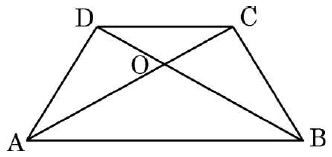
[CBSE 2025 Basic 430/1/1]
Solution:
Basic Proportionality Theorem (Thales theorem):If a line is drawn parallel to one side of a triangle to intersect the other two sides in distinct points, the other two sides are divided in the same ratio.(In , if with D on AB and E on AC, then .)Proof of BPT:In , . Join BE and CD, and draw and ., , so ...(1), , so ...(2) and are on the same base DE and between the same parallels DE and BC, so ...(3)From (1), (2) and (3): .To prove: ABCD is a trapezium, given .Construction: Through O, draw meeting AD at E.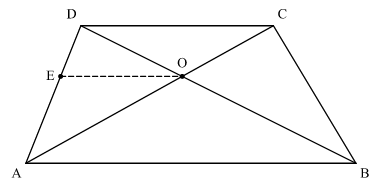 Proof:Given , so ...(i)In , . By BPT, ...(ii)From (i), . So from (ii), ...(iii)In , E lies on AD and O lies on AC, and by (iii) the line EO divides the sides AD and AC in the same ratio. By the converse of BPT, .Now and , so .Result: In quadrilateral ABCD one pair of opposite sides is parallel (), so ABCD is a trapezium.
© examsnet.com
Go to Question: