© examsnet.com
Question : 21 of 83
Marks: +1, -0
(a) If a line is drawn parallel to one side of a triangle to intersect the other two sides in distinct points, then prove that the other two sides are divided in the same ratio.
OR
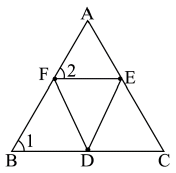
(b) In a △ABC\triangle ABC, F, D and E are mid-points of sides AB, BC and CA respectively. Prove that:
(i) △AFE∼△ABC\triangle AFE \sim \triangle ABC
(ii) △DEF∼△ABC\triangle DEF \sim \triangle ABC
[CBSE 2026 Second Exam Basic 430/7/1]
Solution:  
(a)
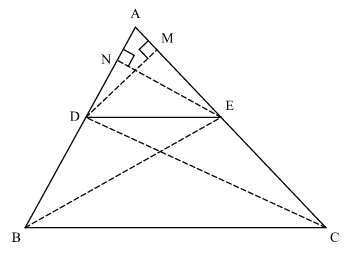
Given: In △ABC\triangle ABC, a line parallel to BC meets AB at D and AC at E, so DE∥BCDE \parallel BC.
To prove: ADDB=AEEC\dfrac{AD}{DB} = \dfrac{AE}{EC}
Construction: Join BE and CD; draw DM⊥ACDM \perp AC and EN⊥ABEN \perp AB.
Proof:
ar(△ADE)ar(△DBE)=12×AD×EN12×DB×EN=ADDB\dfrac{ar(\triangle ADE)}{ar(\triangle DBE)} = \dfrac{\frac{1}{2} \times AD \times EN}{\frac{1}{2} \times DB \times EN} = \dfrac{AD}{DB} ...(i)
ar(△ADE)ar(△DCE)=12×AE×DM12×EC×DM=AEEC\dfrac{ar(\triangle ADE)}{ar(\triangle DCE)} = \dfrac{\frac{1}{2} \times AE \times DM}{\frac{1}{2} \times EC \times DM} = \dfrac{AE}{EC} ...(ii)
△DBE\triangle DBE and △DCE\triangle DCE are on the same base DE and between the same parallels DE and BC, so
ar(△DBE)=ar(△DCE)ar(\triangle DBE) = ar(\triangle DCE) ...(iii)
From (i), (ii) and (iii): ADDB=AEEC\dfrac{AD}{DB} = \dfrac{AE}{EC}. Hence proved.
OR (b)
(i) F and E are mid-points of AB and AC, so AFFB=AEEC=1\dfrac{AF}{FB} = \dfrac{AE}{EC} = 1.
By the converse of the basic proportionality theorem, EF∥BCEF \parallel BC.
So ∠AFE=∠ABC\angle AFE = \angle ABC (corresponding angles, ∠2=∠1\angle 2 = \angle 1).
In △AFE\triangle AFE and △ABC\triangle ABC: ∠AFE=∠ABC\angle AFE = \angle ABC and ∠A\angle A is common.
Hence △AFE∼△ABC\triangle AFE \sim \triangle ABC (AA similarity).
(ii) By the mid-point theorem, the segment joining the mid-points of two sides is parallel to the third side and half of it:
EF∥BCEF \parallel BC, EF=12BCEF = \dfrac{1}{2}BC; DE∥AB\quad DE \parallel AB, DE=12ABDE = \dfrac{1}{2}AB; DF∥AC\quad DF \parallel AC, DF=12ACDF = \dfrac{1}{2}AC
So BDEF, AFDE and DCEF are parallelograms (opposite sides parallel).
Opposite angles of a parallelogram are equal: ∠FDE=∠A\angle FDE = \angle A (AFDE), ∠DEF=∠B\angle DEF = \angle B (BDEF), ∠EFD=∠C\angle EFD = \angle C (DCEF).
Also EFBC=FDCA=DEAB=12\dfrac{EF}{BC} = \dfrac{FD}{CA} = \dfrac{DE}{AB} = \dfrac{1}{2}.
Hence △DEF∼△ABC\triangle DEF \sim \triangle ABC (AAA, or SSS similarity), with D↔AD \leftrightarrow A, E↔BE \leftrightarrow B, F↔CF \leftrightarrow C.
© examsnet.com
Advertisements
Go to Question: