© examsnet.com
Question : 18 of 83
Marks: +1, -0
(a) If a line is drawn parallel to one side of a triangle to intersect the other two sides in distinct points, then prove that the other two sides are divided in the same ratio.
OR
(b)
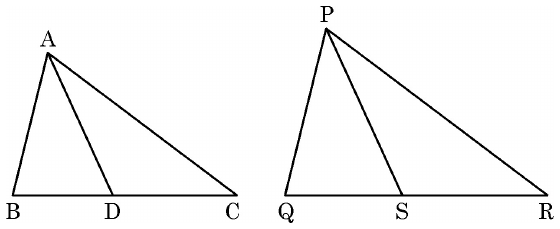
AD and PS are respectively, the medians of △ABC\triangle ABC and △PQR\triangle PQR. If △ABC∼△PQR\triangle ABC \sim \triangle PQR, then prove that
(i) △ADC∼△PSR\triangle ADC \sim \triangle PSR
(ii) ADPS=BCQR\dfrac{AD}{PS} = \dfrac{BC}{QR}
[CBSE 2026 Basic 430/4/3]
Solution:  
(a)
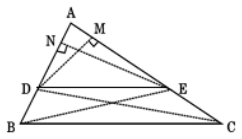
Given: In △ABC\triangle ABC, a line DE ∥\parallel BC meets AB at D and AC at E.
To prove: ADDB=AEEC\dfrac{AD}{DB} = \dfrac{AE}{EC}
Construction: Join BE and CD. Draw DM ⊥\perp AC and EN ⊥\perp AB.
Proof:
Taking EN as the height:
ar(△ADE)ar(△DBE)=12×AD×EN12×DB×EN=ADDB\dfrac{ar(\triangle ADE)}{ar(\triangle DBE)} = \dfrac{\frac{1}{2} \times AD \times EN}{\frac{1}{2} \times DB \times EN} = \dfrac{AD}{DB} ...(i)
Taking DM as the height:
ar(△ADE)ar(△DCE)=12×AE×DM12×EC×DM=AEEC\dfrac{ar(\triangle ADE)}{ar(\triangle DCE)} = \dfrac{\frac{1}{2} \times AE \times DM}{\frac{1}{2} \times EC \times DM} = \dfrac{AE}{EC} ...(ii)
△DBE\triangle DBE and △DCE\triangle DCE are on the same base DE and between the same parallels DE and BC, so
ar(△DBE)=ar(△DCE)ar(\triangle DBE) = ar(\triangle DCE) ...(iii)
From (i), (ii) and (iii): ADDB=AEEC\dfrac{AD}{DB} = \dfrac{AE}{EC}. Hence proved.
OR (b)
(i)
△ABC∼△PQR\triangle ABC \sim \triangle PQR, so the corresponding sides are proportional and the corresponding angles are equal:
ABPQ=ACPR=BCQR\dfrac{AB}{PQ} = \dfrac{AC}{PR} = \dfrac{BC}{QR} and ∠C=∠R\angle C = \angle R
AD and PS are medians, so BC=2DCBC = 2DC and QR=2SRQR = 2SR. Hence
BCQR=2DC2SR=DCSR\dfrac{BC}{QR} = \dfrac{2DC}{2SR} = \dfrac{DC}{SR}
So ACPR=DCSR\dfrac{AC}{PR} = \dfrac{DC}{SR}
In △ADC\triangle ADC and △PSR\triangle PSR:
ACPR=DCSR\dfrac{AC}{PR} = \dfrac{DC}{SR} and the included angle ∠C=∠R\angle C = \angle R
So △ADC∼△PSR\triangle ADC \sim \triangle PSR (SAS similarity). Hence proved.
(ii)
Since △ADC∼△PSR\triangle ADC \sim \triangle PSR, their corresponding sides are proportional:
ADPS=DCSR=12BC12QR=BCQR\dfrac{AD}{PS} = \dfrac{DC}{SR} = \dfrac{\frac{1}{2}BC}{\frac{1}{2}QR} = \dfrac{BC}{QR}
Hence ADPS=BCQR\dfrac{AD}{PS} = \dfrac{BC}{QR}. Hence proved.
© examsnet.com
Advertisements
Go to Question: