© examsnet.com
Question : 14 of 83
Marks: +1, -0
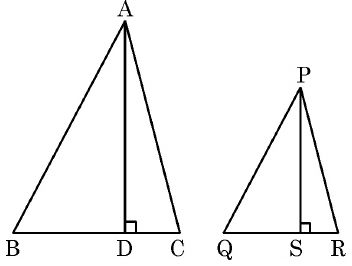
In the given figure, two triangles ABC and PQR are shown such that ∠A=∠P\angle A = \angle P and ∠C=∠R\angle C = \angle R. If AD⊥BCAD \perp BC and PS⊥QRPS \perp QR, then prove that (i) △ADB∼△PSQ\triangle ADB \sim \triangle PSQ (ii) AD×QS=BD×PSAD \times QS = BD \times PS.
[CBSE 2026 Basic 430/5/3]
Solution:  
Given:
∠A=∠P\angle A = \angle P, ∠C=∠R\angle C = \angle R, AD⊥BCAD \perp BC, PS⊥QRPS \perp QR.
(i)
In △ABC\triangle ABC and △PQR\triangle PQR, the angle sum is 180∘180^\circ, so
∠B=180∘−∠A−∠C=180∘−∠P−∠R=∠Q\angle B = 180^\circ - \angle A - \angle C = 180^\circ - \angle P - \angle R = \angle Q
Now in △ADB\triangle ADB and △PSQ\triangle PSQ:
∠ADB=∠PSQ=90∘\angle ADB = \angle PSQ = 90^\circ (given perpendiculars)
∠ABD=∠PQS\angle ABD = \angle PQS (shown above, ∠B=∠Q\angle B = \angle Q)
So △ADB∼△PSQ\triangle ADB \sim \triangle PSQ (AA similarity criterion).
(ii)
Corresponding sides of similar triangles are proportional, so from (i)
ADPS=BDQS\dfrac{AD}{PS} = \dfrac{BD}{QS}
Cross-multiplying: AD×QS=BD×PSAD \times QS = BD \times PS. Hence proved.
Key point: Match the vertices in order: A↔PA \leftrightarrow P, D↔SD \leftrightarrow S, B↔QB \leftrightarrow Q, so ADAD pairs with PSPS and DBDB with SQSQ.
© examsnet.com
Advertisements
Go to Question: