Test Index
Surface Areas and Volumes
Surface Areas and Volumes

 CBSE Board Videos
© examsnet.com
Question : 48 of 51
Marks:
+1,
-0
(a) spherical marbles, each of diameter cm, are dropped in a cylindrical vessel of diameter cm containing some water, and are completely immersed in water. Find the rise in the level of water in the cylindrical vessel.OR(b) Three cubes of side cm each, are joined as shown in Figure 1. Find the total surface area of the resulting cuboid.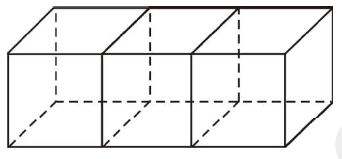 Figure 1
[CBSE 2022 Standard 30/3/1]
Solution:
(a)Concept: The volume of water pushed up in the cylinder equals the total volume of the marbles.Given: radius of each marble cm; radius of the vessel cm; number of marbles . Let the water level rise by cm.Volume of water risen volume of marblesResult: The water level rises by cm.OR (b)When three cubes of side cm are joined end to end, the resulting cuboid haslength cm, breadth cm, height cm.Total surface area Result: Total surface area of the cuboid Key point: Do not just add the surface areas of the three cubes (); the four faces that are joined together are hidden ().
© examsnet.com
Go to Question: