Test Index

Some Applications of Trigonometry Get it on Google PlayDownload on the App Store CBSE Board Videos

© examsnet.com
Question : 41 of 42
Marks: +1, -0
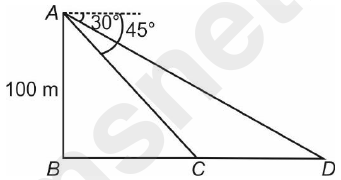
(a) As observed from the top of a light house 100 m100 \text{ m} above sea level, the angle of depression of a ship, sailing directly towards it, changes from 30∘30^\circ to 45∘45^\circ. Determine the distance travelled by the ship during this time.
(Use 3=1.73\sqrt{3} = 1.73)
Fig. 3
OR
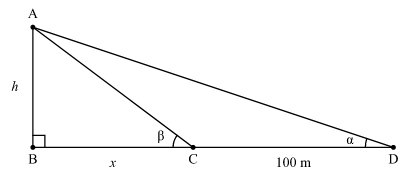
(b) At a point on level ground, the angle of elevation of a vertical tower is found to be α\alpha such that tan⁡α=13\tan \alpha = \dfrac{1}{3}. After walking 100 m100 \text{ m} towards the tower, the angle of elevation β\beta becomes such that tan⁡β=34\tan \beta = \dfrac{3}{4}. Find the height of the tower.
[CBSE 2022 Basic 430/2/1]
Solution:  
(a)
Given:
AB=100 mAB = 100 \text{ m} is the light house. The ship moves from DD (angle of depression 30∘30^\circ) to CC (angle of depression 45∘45^\circ).
Angle of depression from AA = angle of elevation at the ship (alternate angles), so ∠ADB=30∘\angle ADB = 30^\circ and ∠ACB=45∘\angle ACB = 45^\circ.
Solution:
In right △ABC\triangle ABC: tan⁡45∘=ABBC⇒1=100BC⇒BC=100 m\tan 45^\circ = \dfrac{AB}{BC} \Rightarrow 1 = \dfrac{100}{BC} \Rightarrow BC = 100 \text{ m} ...(i)
In right △ABD\triangle ABD: tan⁡30∘=ABBD⇒13=100BD⇒BD=1003 m\tan 30^\circ = \dfrac{AB}{BD} \Rightarrow \dfrac{1}{\sqrt{3}} = \dfrac{100}{BD} \Rightarrow BD = 100\sqrt{3} \text{ m} ...(ii)
Distance travelled CD=BD−BC=1003−100=100(3−1)CD = BD - BC = 100\sqrt{3} - 100 = 100(\sqrt{3} - 1)
=100(1.73−1)=100×0.73=73 m= 100(1.73 - 1) = 100 \times 0.73 = 73 \text{ m}
Result: The ship travels 73 m73 \text{ m}.
OR (b)
Let AB=hAB = h be the tower, DD the first point and CC the point after walking 100 m100 \text{ m}, with BC=xBC = x.
In right △ABD\triangle ABD: tan⁡α=hx+100=13⇒3h=x+100\tan \alpha = \dfrac{h}{x + 100} = \dfrac{1}{3} \Rightarrow 3h = x + 100 ...(i)
In right △ABC\triangle ABC: tan⁡β=hx=34⇒x=4h3\tan \beta = \dfrac{h}{x} = \dfrac{3}{4} \Rightarrow x = \dfrac{4h}{3} ...(ii)
Putting (ii) in (i): 3h=4h3+1003h = \dfrac{4h}{3} + 100
9h=4h+300⇒5h=300⇒h=609h = 4h + 300 \Rightarrow 5h = 300 \Rightarrow h = 60
Result: Height of the tower =60 m= 60 \text{ m}
© examsnet.com
Advertisements
Go to Question: