Test Index

Some Applications of Trigonometry Get it on Google PlayDownload on the App Store CBSE Board Videos

© examsnet.com
Question : 26 of 42
Marks: +1, -0
Case Study – 2
Two poles of different heights stand on level ground and at a distance of 4040 m. Both poles are supported by wires attached from the top of each pole to the bottom of the other. A coupling is placed at point C, where the two wires cross (as shown in the figure).
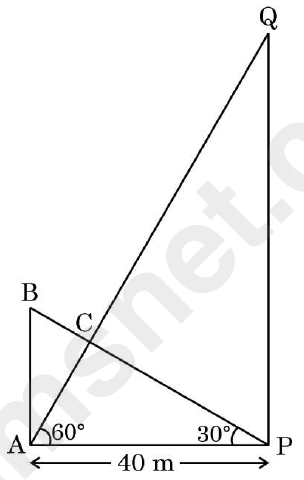
Based on the above information, answer the following questions :
(i) Find the height of pole AB. (1)
(ii) Find the height of pole PQ. (1)
(iii) (a) If the angle of elevation of the top of the pole PQ from the top of the pole AB is 30∘30^\circ, find the distance BQ. (2)
OR
(iii) (b) If the coupling is at a height of 2020 m from the ground, how far down the wire from the smaller pole AB is the coupling ? (2)
[CBSE 2024 Basic 430/5/2]
Solution:  
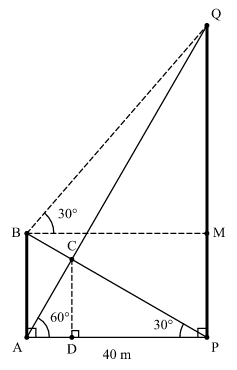
Concept: AB and PQ are vertical poles, AP =40= 40 m. Wire AQ makes 60∘60^\circ with the ground at A, and wire BP makes 30∘30^\circ with the ground at P.
(i)
In right ΔABP\Delta ABP: tan⁡30∘=ABAP\tan 30^\circ = \dfrac{AB}{AP}
13=AB40⇒AB=403=4033\dfrac{1}{\sqrt{3}} = \dfrac{AB}{40} \Rightarrow AB = \dfrac{40}{\sqrt{3}} = \dfrac{40\sqrt{3}}{3} m ≈23.09\approx 23.09 m
(ii)
In right ΔAPQ\Delta APQ: tan⁡60∘=PQAP\tan 60^\circ = \dfrac{PQ}{AP}
3=PQ40⇒PQ=403\sqrt{3} = \dfrac{PQ}{40} \Rightarrow PQ = 40\sqrt{3} m ≈69.28\approx 69.28 m
(iii) (a)
Draw BM ∥\parallel AP to meet PQ at M. Then BM == AP =40= 40 m and ∠QBM=30∘\angle QBM = 30^\circ (angle of elevation of Q from B).
In right ΔBMQ\Delta BMQ: cos⁡30∘=BMBQ\cos 30^\circ = \dfrac{BM}{BQ}
32=40BQ⇒BQ=803=8033\dfrac{\sqrt{3}}{2} = \dfrac{40}{BQ} \Rightarrow BQ = \dfrac{80}{\sqrt{3}} = \dfrac{80\sqrt{3}}{3} m ≈46.19\approx 46.19 m
OR (iii) (b)
Draw CD ⊥\perp AP; the coupling is at height CD =20= 20 m.
C lies on wire AQ, which starts at the foot A of pole AB. In right ΔADC\Delta ADC: sin⁡60∘=CDAC\sin 60^\circ = \dfrac{CD}{AC}
32=20AC⇒AC=403=4033\dfrac{\sqrt{3}}{2} = \dfrac{20}{AC} \Rightarrow AC = \dfrac{40}{\sqrt{3}} = \dfrac{40\sqrt{3}}{3} m ≈23.09\approx 23.09 m
Measured instead along wire BP from the top B of pole AB: BP =APcos⁡30∘=803= \dfrac{AP}{\cos 30^\circ} = \dfrac{80}{\sqrt{3}} m and, in right ΔPDC\Delta PDC, PC =CDsin⁡30∘=40= \dfrac{CD}{\sin 30^\circ} = 40 m,
so BC =803−40=803−1203= \dfrac{80}{\sqrt{3}} - 40 = \dfrac{80\sqrt{3} - 120}{3} m ≈6.19\approx 6.19 m.
© examsnet.com
Advertisements
Go to Question:

