Test Index
Probability
Probability

 CBSE Board Videos
© examsnet.com
Question : 32 of 74
Marks:
+1,
-0
A game of chance consists of spinning a wheel which comes to rest at one of the numbers from to (as shown in the given figure) with equal probabilities.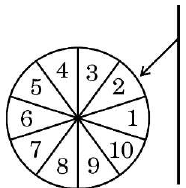 What is the probability that the wheel stops at(i) a prime number greater than ?(ii) an odd number less than ?(iii) a multiple of ?
[CBSE 2025 Basic 430/2/2]
Solution:
Concept: Total possible outcomes (numbers to , all equally likely).(i) Prime numbers greater than : → outcomes(ii) Odd numbers less than : → outcomes(iii) Multiples of : → outcomesResult: (i) (ii) (iii) Key point: is neither prime nor composite, and is not counted in (ii) because the number must be less than .
© examsnet.com
Go to Question: