Test Index
Polynomials
Polynomials

 CBSE Board Videos
© examsnet.com
Question : 49 of 61
Marks:
+1,
-0
Case Study – 2Rainbow is an arch of colours that is visible in the sky after rain or when water droplets are present in the atmosphere. The colours of the rainbow are generally, red, orange, yellow, green, blue, indigo and violet. Each colour of the rainbow makes a parabola. We know that any quadratic polynomial represents a parabola on the graph paper.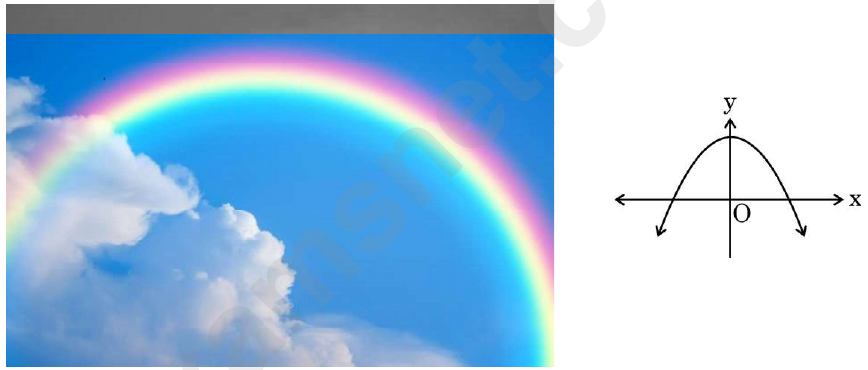 Based on the above, answer the following questions :(i) The graph of a rainbow is shown in the figure. Write the number of zeroes of the curve. (1)(ii) If the graph of a rainbow does not intersect the -axis but intersects -axis at one point, then how many zeroes will it have ? (1)(iii) (a) If a rainbow is represented by the quadratic polynomial , whose zeroes are and , find the value of and . (2)OR(iii) (b) The polynomial represents a rainbow. If is a zero of it, find the value of . (2)
[CBSE 2023 Basic 430/5/3]
Solution:
(i) The number of zeroes of is the number of points where the graph meets the -axis. The curve cuts the -axis at points, so it has zeroes.(ii) Zeroes are given only by the points on the -axis. A graph that does not meet the -axis has no zero ( zeroes); meeting the -axis does not give a zero.(iii) (a) , zeroes and .Sum of zeroes Product of zeroes Result: , OR (iii) (b) is a zero, so :Result:
© examsnet.com
Go to Question: