Test Index
Polynomials
Polynomials

 CBSE Board Videos
© examsnet.com
Question : 42 of 61
Marks:
+1,
-0
Case Study – 3In a pool at an aquarium, a dolphin jumps out of the water travelling at cm per second. Its height above water level after seconds is given by .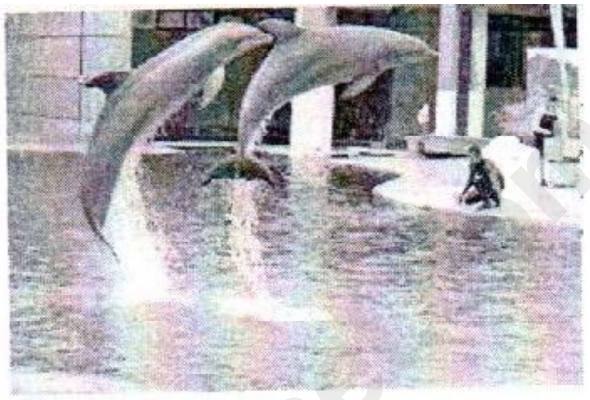 Based on the above, answer the following questions :(i) Find zeroes of polynomial . (1)(ii) Which of the following types of graph represents ? (1)
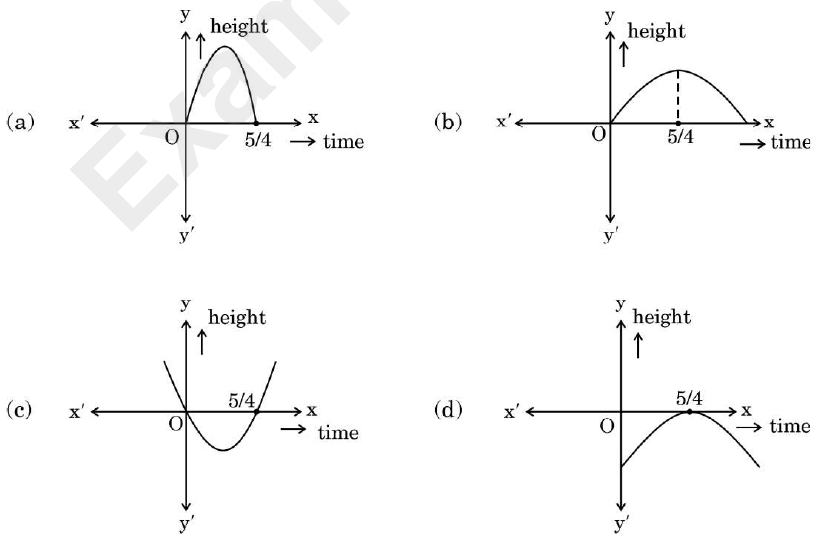 (iii) (a) What would be the value of at ? Interpret the result. (2)OR(iii) (b) How much distance has the dolphin covered before hitting the water level again ? (2)
[CBSE 2023 Standard 30/5/1]
Solution:
(i) or Zeroes: and (ii) Graph (a).The coefficient of is negative (), so the graph is a parabola opening downward, and it cuts the time axis at and . Graph (b) meets the axis beyond , (c) opens upward, and (d) does not pass through O.(iii) (a) At : Interpretation: is negative, so the point is below the water level: after s the dolphin is 6 cm below the water surface (it had re-entered the water at s).OR (iii) (b) The dolphin is above water from to s (the zeroes of ).It travels at 20 cm per second, so distance covered cm.
© examsnet.com
Go to Question: