Test Index
Coordinate Geometry
Coordinate Geometry

 CBSE Board Videos
© examsnet.com
Question : 11 of 81
Marks:
+1,
-0
In the given figure, PQ is a tangent to a circle with centre . If coordinates of P and Q are and respectively, then using distance formula, show that .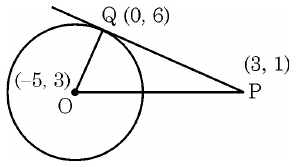
[CBSE 2026 Basic 430/5/3]
Solution:
Concept:Distance formula: . If the sides of a triangle satisfy , the angle opposite is (converse of Pythagoras theorem).Solution:, , By the converse of Pythagoras theorem, is right-angled at Q, i.e. .Hence . Hence proved.Key point: This agrees with the theorem that a tangent is perpendicular to the radius through the point of contact.
© examsnet.com
Go to Question: