Test Index
Circles
Circles

 CBSE Board Videos
© examsnet.com
Question : 9 of 85
Marks:
+1,
-0
In the figure, AB and CD are two parallel tangents to a circle with centre O and another tangent PQ with point of contact M, intersecting AB at P and CD at Q. Prove that .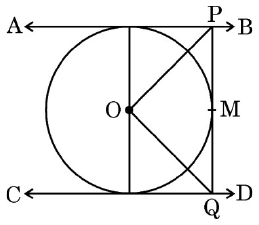
[CBSE 2026 Second Exam Standard 30/7/1]
Solution:
Let AB touch the circle at E and CD touch it at F. Join OE, OF, OM, OP and OQ.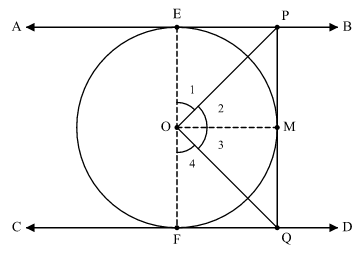 Step 1: E, O, F lie on one line.OE AB and OF CD (radius tangent). Since AB CD, OE and OF are perpendicular to the same direction through O, so EOF is a diameter and ...(i)(where , , , )Step 2: .In OEP and OMP:OE OM (radii), PE PM (tangents from P), OP OP (common).So (SSS) and (CPCT) ...(ii)Step 3: .Similarly, (OM OF, QM QF, OQ common), so ...(iii)Step 4: Using (ii) and (iii) in (i):But .Hence . Proved.
© examsnet.com
Go to Question: