Test Index
Circles
Circles

 CBSE Board Videos
© examsnet.com
Question : 84 of 85
Marks:
+1,
-0
(a) Prove that a parallelogram circumscribing a circle is a rhombus.OR(b) Prove that the perpendicular at the point of contact to the tangent to a circle passes through the centre of the circle.
[CBSE 2022 Basic 430/2/1]
Solution:
(a)Given: Parallelogram circumscribes a circle; its sides , , , touch the circle at , , , .To prove: is a rhombus.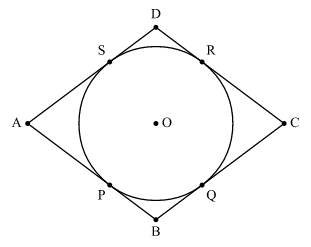 Proof:Tangents drawn from an external point to a circle are equal in length. So, , , Adding: In a parallelogram and , so Hence , so is a rhombus. Proved.OR (b)Given: A circle with centre ; is the tangent at the point of contact .To prove: The perpendicular to at passes through .
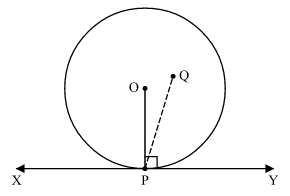 Proof:Suppose the perpendicular to at does not pass through ; let it be , so .Join . is a radius and the tangent at a point is perpendicular to the radius through that point, so .Then , which is possible only when and are the same line, i.e. lies on .This contradicts our supposition. Hence the perpendicular at the point of contact to the tangent passes through the centre . Proved.
© examsnet.com
Go to Question: