Test Index
Circles
Circles

 CBSE Board Videos
© examsnet.com
Question : 77 of 85
Marks:
+1,
-0
(a) A quadrilateral ABCD is drawn to circumscribe a circle, as shown in the figure. Prove that .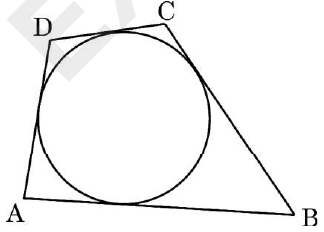 OR(b) Prove that the parallelogram circumscribing a circle is a rhombus.
[CBSE 2023 Basic 430/2/1]
Solution:
(a)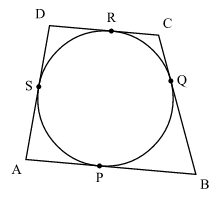 Let the circle touch AB, BC, CD and DA at P, Q, R and S.Tangents drawn from an external point to a circle are equal in length:, , , Adding, (proved)OR (b)Let the parallelogram ABCD circumscribe a circle, touching AB, BC, CD, DA at P, Q, R, S.Exactly as in (a), using equal tangents (, , , ):In a parallelogram, opposite sides are equal: and .So : all sides are equal.Result: The parallelogram is a rhombus.
© examsnet.com
Go to Question: