Test Index
Circles
Circles

 CBSE Board Videos
© examsnet.com
Question : 53 of 85
Marks:
+1,
-0
(a) Prove that the parallelogram circumscribing a circle is a rhombus.OR(b) Prove that the lengths of the tangents drawn from an external point to a circle are equal.
[CBSE 2024 Basic 430/5/2]
Solution:
(a)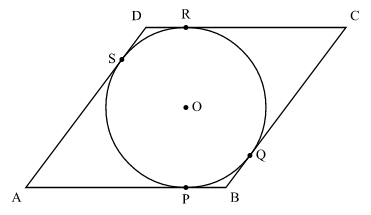 Given: ABCD is a parallelogram whose sides AB, BC, CD and DA touch a circle at P, Q, R and S.To prove: ABCD is a rhombus.Proof: Tangents drawn from an external point to a circle are equal in length. SoAP AS ...(i)BP BQ ...(ii)CR CQ ...(iii)DR DS ...(iv)Adding (i), (ii), (iii) and (iv):AP BP CR DR AS BQ CQ DS(AP PB) (CR RD) (AS SD) (BQ QC)AB CD AD BC ...(v)In a parallelogram opposite sides are equal: AB CD and AD BC. Putting these in (v):AB AD AB ADSo AB BC CD DA, and ABCD is a rhombus. Hence proved.OR (b)
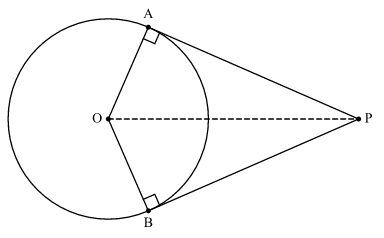 Given: PA and PB are tangents from an external point P to a circle with centre O, touching it at A and B.To prove: PA PBConstruction: Join OA, OB and OP.Proof: The radius is perpendicular to the tangent at the point of contact, so .In right triangles OAP and OBP:OA OB (radii of the same circle)OP OP (common hypotenuse)So (RHS congruence rule).Therefore PA PB (CPCT). Hence proved.
© examsnet.com
Go to Question: