Test Index
Circles
Circles

 CBSE Board Videos
© examsnet.com
Question : 5 of 85
Marks:
+1,
-0
PQ and PR are two tangents to a circle with centre O and radius 5 cm. AB is another tangent to the circle at C which lies on OP. If OP = 13 cm, then find the length AB and PA.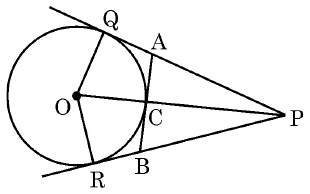
[CBSE 2026 Standard 30/5/3]
Solution:
Concept: A tangent is perpendicular to the radius at the point of contact, and the two tangents from an external point are equal.Given: OQ = OC = 5 cm, OP = 13 cm, AB touches the circle at C on OP.Solution:In right (): cmC lies on OP, so cm.Let AC = x. A is outside the circle, so tangents AC and AQ are equal: AQ = x.Then .AB is a tangent at C, so , i.e. . In right : cmBy symmetry about OP, BC = AC, so cm cmResult: cm cm and cm cm
© examsnet.com
Go to Question: