Test Index
Circles
Circles

 CBSE Board Videos
© examsnet.com
Question : 45 of 85
Marks:
+1,
-0
(a) Prove that opposite sides of a quadrilateral circumscribing a circle subtends supplementary angles at the centre of the circle.OR(b) If O is the centre of a circle, PQ is a chord and the tangent PR at P makes an angle of with PQ, then find the measure of .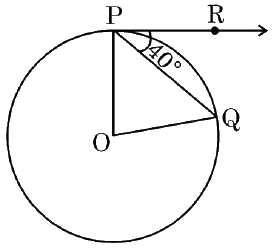
[CBSE 2024 Basic 430/4/1]
Solution:
(a)Given: A quadrilateral ABCD circumscribes a circle with centre O. The sides AB, BC, CD and DA touch the circle at P, Q, R and S.To prove: and Construction: Join OP, OQ, OR, OS and OA, OB, OC, OD.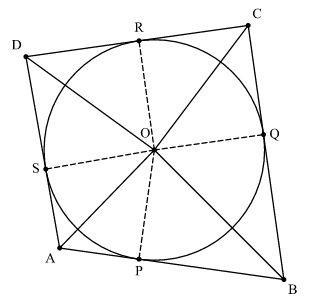 Proof:In and : (radii) (tangents from an external point are equal) (common) (SSS), so Similarly, , and .The eight angles at O together make a complete angle:Using the equal pairs:In the same way, gives .So the opposite sides subtend supplementary angles at the centre. Hence proved.OR (b)Given: between the chord PQ and the tangent PR.The tangent is perpendicular to the radius at the point of contact: In , (radii), so (angles opposite equal sides)Result:
© examsnet.com
Go to Question: