Test Index
Circles
Circles

 CBSE Board Videos
© examsnet.com
Question : 32 of 85
Marks:
+1,
-0
(a) If two tangents inclined at an angle of are drawn to a circle of radius 3 cm, then find the length of each tangent.OR(b) Prove that the tangents drawn at the ends of a diameter of a circle are parallel.
[CBSE 2024 Standard 30/5/3]
Solution:
(a)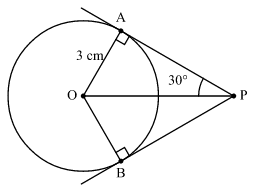 Let and be the tangents from , with , and the centre, cm. bisects , so . Also (radius tangent).In right : cmResult: Each tangent cm ( cm).OR (b)
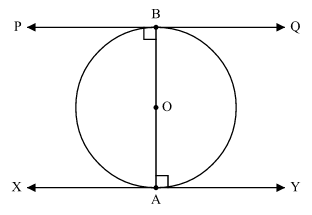 Given: is a diameter of a circle with centre ; is the tangent at and the tangent at .To prove: Proof: The radius is perpendicular to the tangent at the point of contact, so and So . These are alternate interior angles made by the transversal with and .Hence .
© examsnet.com
Go to Question: