© examsnet.com
Question : 3 of 85
Marks: +1, -0
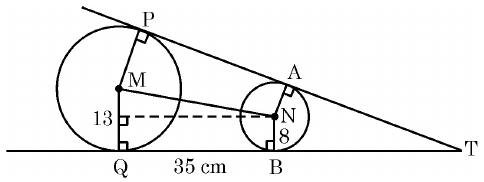
In the given figure, TP and TQ are tangents to a circle with centre M, touching another circle with centre N at A and B respectively. It is given that MQ=13MQ = 13 cm, NB=8NB = 8 cm, BQ=35BQ = 35 cm and TP=80TP = 80 cm.
(i) Name the quadrilateral MQBN. [1]
(ii) Is MN parallel to PA ? Justify your answer. [1]
(iii) Find length TB. [1]
(iv) Find length MN. [2]
[CBSE 2026 Standard 30/4/3]
Solution:  
Concept:
A radius is perpendicular to the tangent at the point of contact, and the two tangents drawn from an external point to a circle are equal.
(i) MQ⊥TQMQ \perp TQ and NB⊥TQNB \perp TQ (radius ⊥\perp tangent), so MQ∥NBMQ \parallel NB. The other pair of sides, QB and MN, are not parallel (because MQ≠NBMQ \ne NB).
Exactly one pair of opposite sides is parallel, so MQBN is a trapezium (a right trapezium, ∠Q=∠B=90∘\angle Q = \angle B = 90^\circ).
(ii) No. MP⊥PAMP \perp PA and NA⊥PANA \perp PA, so MP∥NAMP \parallel NA. If MN were also parallel to PA, then MPAN would be a rectangle and we would need MP=NAMP = NA. But MP=13MP = 13 cm and NA=8NA = 8 cm, so MP≠NAMP \ne NA. Hence MN is not parallel to PA.
(iii) TP and TQ are tangents from the external point T to the circle with centre M, so
TQ=TP=80TQ = TP = 80 cm
TB=TQ−BQ=80−35=45TB = TQ - BQ = 80 - 35 = 45 cm
(iv) Draw NS⊥MQNS \perp MQ (the dashed line in the figure). Then SQBN is a rectangle, so
NS=BQ=35NS = BQ = 35 cm and SQ=NB=8SQ = NB = 8 cm, so MS=MQ−SQ=13−8=5MS = MQ - SQ = 13 - 8 = 5 cm.
In right △MSN\triangle MSN (Pythagoras theorem):
MN2=NS2+MS2=352+52=1225+25=1250MN^2 = NS^2 + MS^2 = 35^2 + 5^2 = 1225 + 25 = 1250
MN=1250=252≈35.36MN = \sqrt{1250} = 25\sqrt{2} \approx 35.36 cm
Result: (i) Trapezium (ii) No (iii) TB=45TB = 45 cm (iv) MN=252MN = 25\sqrt{2} cm
© examsnet.com
Advertisements
Go to Question:

