Test Index
Circles
Circles

 CBSE Board Videos
© examsnet.com
Question : 21 of 85
Marks:
+1,
-0
In the given figure, is a tangent to the circle at . is the diameter which when extended meets the tangent at . Find and , if .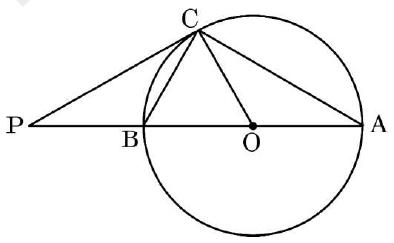
[CBSE 2025 Standard 30/3/1]
Solution:
Concepts used:1. Angle in a semicircle is .2. The tangent at a point is perpendicular to the radius through the point of contact.3. Angles opposite equal sides of a triangle are equal.Solution: is a diameter, so (angle in a semicircle). (radius tangent), so .In , (radii), so .Since lies on , .Check: in , , as the alternate segment theorem requires.Result: and
© examsnet.com
Go to Question: