Test Index
Arithmetic Progressions
Arithmetic Progressions

 CBSE Board Videos
© examsnet.com
Question : 2 of 53
Marks:
+1,
-0
'Kolam' is a decorative art which is made with rice flour in South Indian States. It is drawn on grid pattern of dots. One such art work is shown below.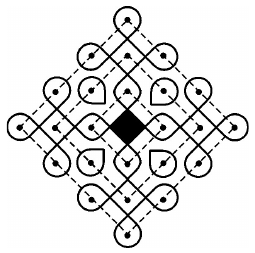 Observe the given figure carefully. There are dots in first square, dots in second square, dots in third square and so on.Based on the above, answer the following questions :(i) Show that number of dots given above form an A.P. Write the first term and common difference. [1](ii) Write term of the A.P. formed. [1](iii) (a) The pattern is expanded on a large ground. If total dots are used, then find the number of squares formed. [2]OR(iii) (b) Is it possible to complete number of squares using dots ? If yes, then find the value of .
[CBSE 2026 Standard 30/4/3]
Solution:
(i) Dots in the squares: and : the difference between consecutive terms is the same, so the numbers form an A.P.First term , common difference .(ii) (iii) (a) Total dots in squares (as is not possible).Result: squares are formed.OR (iii) (b) Take : is not a perfect square, so is not a natural number. (Check: and ; no natural gives .)Result: No, it is not possible to complete a whole number of squares using exactly dots.
© examsnet.com
Go to Question: