Test Index
CBSE Class 10 English 2023 Paper 2/5/1
CBSE Class 10 English 2023 Paper 2/5/1


© examsnet.com
Question : 2 of 11
Marks:
+1,
-0
Read the following passage carefully :(1) Unsafe water kills more people each year than do war and all other forms of violence combined. Meanwhile, our drinkable water sources are finite : less than 1 percent of the Earth’s freshwater is actually accessible to us. Without action, the challenges will only increase by 2050, when global demand for freshwater is expected to be one-third greater than it is now.(2) Water is uniquely vulnerable to pollution. Known as a “universal solvent”, water is able to dissolve more substances than any other liquid on Earth. Water pollution is the release of substances into subsurface groundwater or into lakes, streams, rivers, estuaries, and oceans to the point where the substances interfere with beneficial use of the water or with the natural functioning of ecosystems. In addition to the release of substances, such as chemicals, trash, or microorganisms, water pollution may also include the release of energy, in the form of radioactivity or heat, into bodies of water. The key causatives of water pollution in India are urbanization, deforestation, industrial effluents and agricultural run-offs with the use of insecticides and pesticides. The other causes are social and religious offerings in water bodies and the use of detergents and fertilizers.(3) Water pollution can have disastrous consequences on the ecosystem. Furthermore, toxic chemicals can travel through the food chain and get into our bodies, causing diseases and death.(4) There is no single or simple answer to stop the water pollution crisis. However, there are many solutions to prevent water pollution, both in our daily lives and within industries. They are wastewater treatment, reducing plastic waste and water conservation. In addition to this, we must have water-efficient toilets, stormwater management and ozone wastewater treatment.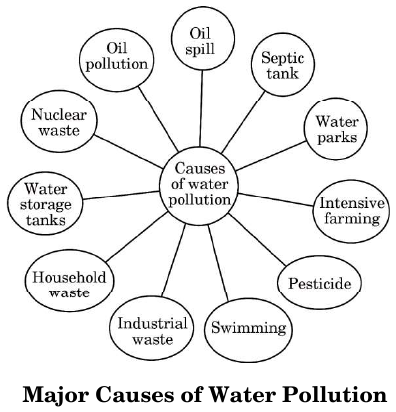 Based on your understanding of the passage, answer the questions given below : (10×1=10)(i) Infer one reason for the following, based on information in para 1.Less than 1 percent of the Earth’s freshwater is actually accessible to us.(ii) Select the appropriate option to fill in the blank :Water is uniquely vulnerable to __________.(a) season(b) pollution(c) water bodies(d) extreme weather conditions(iii) Complete the following analogy correctly with a word/phrase from paragraph 2 :vulnerable : resilient : : artificial : __________(Clue : just as resilient is the opposite of vulnerable, similarly the opposite of artificial is __________.)(iv) Select the correct option to complete the following sentence :Water pollution can have disastrous consequences on __________.(a) the ecosystem(b) weather conditions(c) unexpected rainfall(d) flash floods(v) From the chart, identify two causes of water pollution in our homes.(vi) Fill in the blank by selecting the correct option :One of the solutions of preventing water pollution is __________.(a) building industries near water bodies(b) water conservation and reducing plastic waste(c) avoiding swimming(d) reducing farming(vii) Substitute the word ‘causative’ with one word similar in meaning in the following sentence :The key causative of water pollution in India must be addressed.(viii) According to the writer, water pollution is defined as __________. (Para 2)(ix) List one way in which religious rituals impact water bodies.(x) Select the most suitable title for the passage from the following :(a) Water Pollution — A Concern(b) Unsafe Water — A Menace(c) Universal Solvent — Water(d) Global Concern — An Urgent Need
Go to Question: