Test Index
CBSE Class 12 Physics 2016 Delhi Set 1 Paper
© examsnet.com
Question : 25 of 26
Marks:
+1,
-0
(i) In Young's double slit experiment, deduce the condition for (a) constructive, and (b) destructive interference at a point on the screen. Draw a graph showing variation of intensity in the interference pattern against position ' ' on the screen.(ii) Compare the interference pattern observed in Young's double slit experiment with single slit diffraction pattern, pointing out three distinguishing features. OR(i) Plot a graph to show variation of the angle of deviation as a function of angle of incidence for light passing through a prism. Derive an expression for refractive index of the prism in terms of angle of minimum deviation and angle of prism.(ii) What is dispersion of light? What is its cause?(iii) A ray of light incident normally on one face of a right isosceles prism is totally reflected as shown in fig. What must be the minimum value of refractive index of glass? Give relevant calculations. 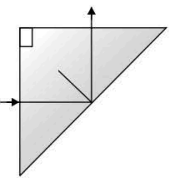
Solution:
(i) Deduce the conditions for a) constructive and b) destructive interference Graph showing the variation of intensity (ii) Three distinguishing features (i)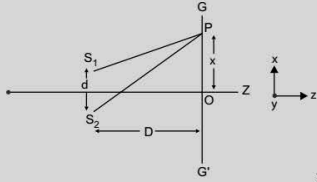 From figure Path difference For For constructive interference , For destructive interference
 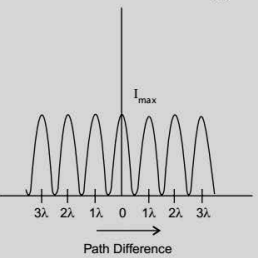 (ii) (a) The Interference pattern has number of equally spaced bright and dark bands, while in the diffraction pattern the width of the central maximum is twice the width of other maxima. (b) In Interference all bright fringes are of equal intensity, whereas in the diffraction pattern the intensity falls as order of maxima increases. (c) In Interference pattern, maxima occurs at angle , where is the slit width, whereas in diffraction pattern, at the same angle, first minimum occurs. (Here ' ' is the size of the slit) OR(i) Plot showing the variation of the angle of deviation as a function of angle of incidence Derivation of expression of refractive index (ii) Definition of dispersion and its cause (iii) Calculation of minimum value of refractive index
 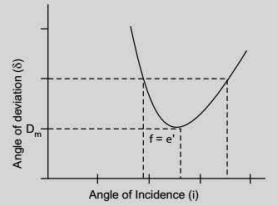 (i) From figure which implies Using (ii) The phenomenon of splitting of white light into its constituent colours. Cause : Refractive index of the material is different for different colours. According to the equation, , where is the angle of prism, different colours will deviate through different amount.
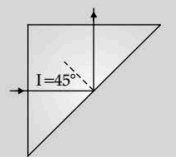 For total internal reflection, Hence, the minimum value of refractive index must be
© examsnet.com
Go to Question: