According to the Ohm's law, the potential difference
(V) across the ends of a resistor is directly proportional to the current (I) flowing through it provided its temperature remains the same.
i.e.,
V∝Ior
IV= constant =Ror
V=RI. Here
R is a constant for the given resistor at a given temperature and is called its resistance.
The SI unit of resistance is ohm
(Ω).
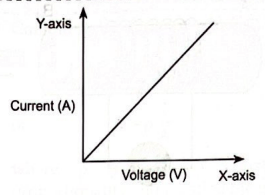
A graph between the potential difference across the two ends of a resistor and the current passing through it is a straight line passing through the origin. The slope of this graph gives the resistance
R of the resistor.
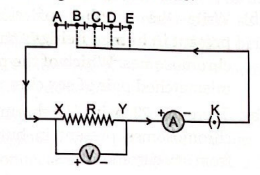
To verify the Ohm's law, we measure the potential difference across the two ends of a resistor at different currents through it in an electric circuit. The current through the resistor is measured by connecting an ammeter in series with it. The potential difference across the two ends of the resistor is measured by connecting the voltmeter in parallel with it.
A straight-line graph obtained between
V and I verify the ohm's law.